
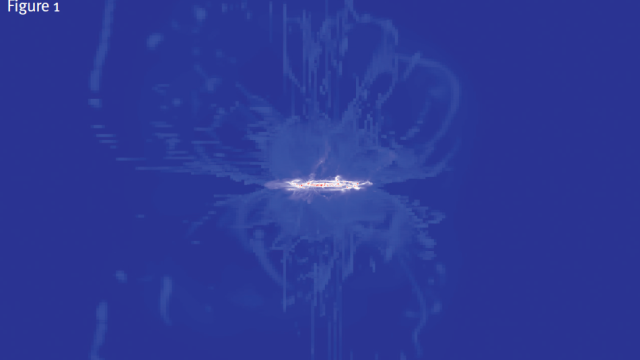
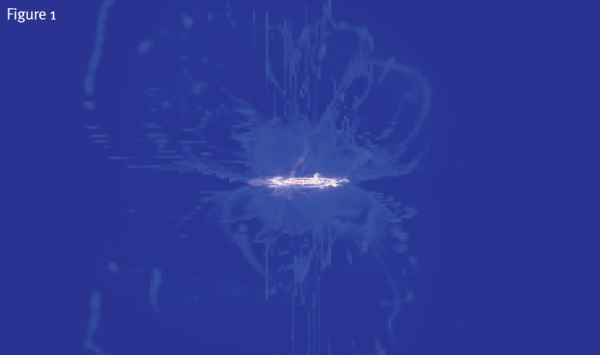
When a galaxy stops forming stars, the remaining stars will slowly fade away and the galaxy will “die”. But what causes this to happen? Orianne Roos has been simulating primeval star-forming galaxies to try and understand how winds from stars and supermassive black holes can couple to affect the gas content of the galaxy and its ability to form new stars.
The observable universe contains several hundred billion galaxies, including ours: the Milky Way. Galaxies are gigantic, mostly disk-shaped structures made of gas, stars, dust and dark matter and can be observed by collecting the light they emit. Orianne Roos and her colleagues from the Astrophysics Department of CEA-Saclay have been looking to solve two key astrophysical problems: what physical mechanism makes galaxies suddenly stop forming stars, and why do numerical models create galaxies which are too massive compared to observations? Nowadays, telescopes such as the Very Large Telescope and the Hubble Space Telescope are so powerful that the details they are able to probe inside galaxies can only be explained by accurately modelling their internal physics with numerical simulations.
Such simulations are so complex that astrophysicists need advanced high performance computing (HPC) techniques to be able to execute them. With supercomputers like Curie and organisations like PRACE, astrophysicists now have the means to actually run these simulations. Roos wrote a proposal to look at whether supermassive black holes and stars are able to create outflows powerful enough to remove a substantial amount of gas from their galaxy and stop its star formation activity, and was granted 11 million core hours on the Curie supercomputer.
“A galaxy is “alive” as long as it is changing the gas it contains into stars. When the star formation process stops, the galaxy “dies”, as its old stars slowly fade away,” explains Roos. “In this research project, known as “POGO: Physical origins of galactic outflows”, we focused on the physical mechanisms that are likely to kill galaxies.”
Supermassive black holes found at the centre of most massive galaxies are a likely cause for the death of galaxies. Such black holes are so massive that they attract gas clouds and stars orbiting near the galactic center. As matter falls on the black hole, it becomes extremely luminous. The central region of the galaxy — its nucleus — is then said to be active, and is known as an active galactic nucleus (AGN). Gas surrounding the AGN is illuminated, heated, and pushed outside the galaxy. In principle, these outflows (or winds) can clear out the galaxy of its gas, suppressing star formation and therefore killing it.
Similarly, stars can also create galactic winds, though they are less powerful. Such stellar winds are slow galactic fountains that recycle the gas of massive galaxies, and are not able to remove gas from massive galaxies on their own. Lower-resolution simulations and theory predict that AGN and stellar winds strongly couple to each other, and give birth to ultra-fast outflows, able to blow away the entire gas content of the galaxy. The goal of Roos’ project is to verify these theoretical arguments with very high-resolution adaptive mesh refinement (AMR) simulations. The typical size of the dark matter halo of a galaxy is 1 000 000 light-years, and the resolution of these simulations can go to five light-years.
A galaxy is alive as long as it is changing the gas it contains into stars. When the star formation process stops, the galaxy dies.
Roos describes what her thoughts were before starting the project: “If the coupling between AGN and stellar winds is physical and ultra-fast outflows are created in our simulations, that would help to explain why galaxies suddenly die and expel their gas content. However, if wind-driving mechanisms do not strongly couple, and therefore do not create super-winds in our simulations, astrophysicists will have to find another culprit, i.e. another physical phenomenon able to stop star formation and starve a galaxy.”
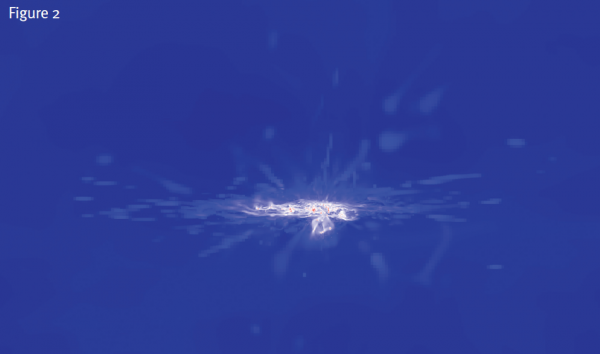
At present, the physical mechanism that makes galaxies suddenly stop forming stars is not known, nor why models predict galaxies that are too massive. “Galactic winds could expel most of the gas mass in the intergalactic medium, but this remains to be proven,” says Roos. To do that, her team has been running high performance galaxy simulations with massively parallel computation techniques. The ultra-high-resolution HPC simulations project, POGO (Physical Origins of Galactic Outflows), has modeled the outflows driven by the stars and the AGN together at very high resolution for the first time. There are technical difficulties with these simulations. Slow stellar outflows propagate in the circumgalactic medium on long timescales, while AGN winds reach high velocities (~3,000 km/s on average) that impose short numerical time steps. This makes galaxy simulations 4-5 times longer, even if computing the AGN-related physics is not expensive itself. This is why the study of coupled stellar and AGN driven outflows requires the use of the most powerful supercomputers.
“In this research project, known as “POGO: Physical origins of galactic outflows”, we focused on the physical mechanisms that are likely to kill galaxies”
The simulations are now beginning to produce interesting scientific results. “We can see that even though the AGN is the main driver of the outflows (which was expected only for massive galaxies), the mass of the galaxy and the presence of stellar outflows significantly changes the mass swept away by the outflows,” says Roos.
The team has also demonstrated that non-linear coupling occurs between stellar outflows and AGN outflows. Stellar outflows redistribute gas from the centre of the galactic disk in all sizes of galaxies, which decreases the amount of gas that AGN outflows can sweep away. In low mass galaxies, however, strong stellar outflows can lift large amounts of gas, adding to the amount that is swept away by the AGN outflows, but in intermediate and high mass galaxies the stellar outflows are too weak to lift the gas for long enough. Overall, this gives low mass galaxies a net increase in the amount of gas swept away compared to just AGN alone, while intermediate and high mass galaxies see a net decrease.
Now that the technical goals of the work have been achieved and the simulations have been completed, the researchers are now writing papers for publication in international peer-reviewed journals and for presentation at professional meetings. The results from this work are some of the first clues pointing towards a solution to a long-known problem in astrophysics: why is the fraction of gas outside galaxies so important? The outflows generated by the coupling of those generated by the AGN and the stars could very well be the beginning of the answer.
Project Title: POGO – The Physical Origins of Galactic Outflows
Project Leader: Orianne Roos, CEA-Saclay, France
Resource Awarded: 11 million core hours on Curie hosted by CEA at GENCI, France
Further information on the POGO project: http://astrorianne.scienceontheweb.net/index.php/en/the-pogo-project.html