

The SunFlare project group has studied the relationship between the sub-surface layers and visible layers of the Sun, with a focus on its active regions. The dynamics in the visible layers of the active solar regions is the result of processes that take place in the sub-surface layers. By using the largest plasma simulations ever conducted in solar research, the project team unearthed a basic mechanism responsible for accelerating charged particles on the Sun.
The main objective of the SunFlare projectis modelling and understanding thecouplings between the sub-surface layersand visible layers of the Sun: the solar photosphere,chromosphere and corona.
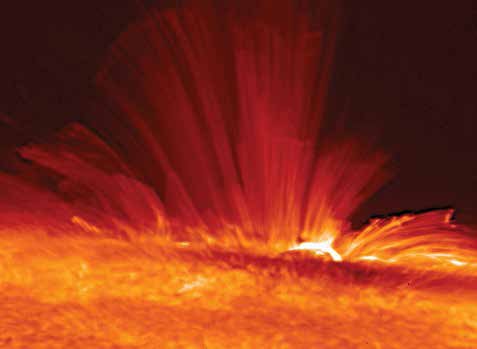
“The mass density is much larger in the subsurfacelayers than in the visible layers. The kineticand magnetic energy densities are alsocorrespondingly large. The motions that occurin these layers cover a wide scale range. Themotions transport heat to the surface of the Sun,allowing the Sun to maintain its enormous energyoutput. The motions also generate, stretch, andtransport magnetic fields to the surface and, asour simulations have shown for the first time,spontaneously create the structure in so-calledsolar Active Regions”, professor Åke Nordlundfrom the University of Copenhagen explains.Nordlund heads the team. He is a science coordinatoras well as a program developer andworks closely with the SunFlare project group.
When magnetic fields emerge on the surfaceof the Sun the energy can be violently releasedin the form of so-called Solar flares and CoronalMass Ejections (CMEs).
“Solar flares are extremely powerful explosiveevents, which ultimately may affect theenvironment in the Earth’s protective magnetosphere.The explosions are often closely accompaniedby CMEs, where magnetic energyis converted into intense UV-light emissions, Xrays,gamma rays, as well as highly chargedparticles. The particles can travel into interplanetaryspace, resulting in northern lights andmagnetic sub-storms in the Earth’s magnetosphere”, Nordlund explains.
Coupling traditional MHD models withkinetic particle models
The team primarily made use of two kinds of supercomputerprograms in the study.
“One program type solves equations thatdescribe the dynamics of magnetized plasma asa fluid. The other treats the same situation in aparticle representation, where the gas is representedby up to more than 100 billion pseudoparticles,which are characterized by their mass,electrical charge, and velocity”, Nordlund says.
“There are many groups studying the solaratmosphere with supercomputer models, butour group is unique in that it studies all aspects,and does so by coupling traditional MHD modelswith kinetic particle models. Our models arevery detailed and realistic and are readily comparedto observations. Sometimes observationsare even used as a starting point for data-drivensimulations. Furthermore, our MHD modelsare some of the most extensive and computedemandingever conducted and, certainly, ourplasma models are the largest ever created ina solar context”, Nordlund explains.

Illustration of the particle tracing used to understand acceleramechanisms in the solar corona: the upper panels present two planes, cut out from a larger simulation. They are both centred on the reconnection point, marked with a cross, where the magnetic field topology changes. The gray scale pictures show the projected electrical currents, with darker shades representing stronger currents. The trajectories of high energy particles are plotted on top. a) is a horizontal cut in the solar corona, and b) is a vertical cut. The small graphs present the time evolution for individual particles. From top to bottom are the energy evolution, the local accelerating electric field, the angle particles make with the local magnetic fields, and the size of their gyro radius. It can be seen how all the high energy particles move along the strongest currents, almost perfectly aligned with the magnetic field lines, and accelerated by the local electric field.
Revealing the charged particle acceleration mechanism
The SunFlare team has been able to reveal a basic mechanism responsible for accelerating charged particles on the Sun.
“The dominant physical process was onlyclearly discovered while running the largest particle-in-cell simulation on JUGENE-supercomputer,with over 3 billion mesh points and more than 135 billion pseudo-particles”, Nordlund says.
Smaller simulations had shown indications of the process, but only the largest simulation was able to conclusively show what occurs.
“A strong electric field develops along thesolar magnetic field. As a result, charged particles are accelerated. Protons are accelerated in the direction of the electric field and electronsin the opposite direction. The spatial distribution of the simulated particles agrees well with whatwe infer from observations of active regions on the Sun”, Nordlund says.
The Sun is presently entering its next solar maximum of magnetic activity, Solar Cycle #24,which culminates in 2013. It is believed that solar magnetic activity is directly responsible for launching CMEs into the solar system.
“Our results provide a strong foundation for continued research on the launching of solarstorms, propagation of CME-driven plasmas through the solar system, and resulting space weather events that are driven by the interaction between accelerated solar wind (a solar storm)and the Earth’s magnetosphere. Some unresolved questions remain. The modelled events are active regions, but the particle acceleration events modelled so far, so-called “pre-flares”,are not the most energetic. We are still unable to model the most powerful energetic explosions in the solar corona”, Nordlund says.
This research has provided detailed insights into processes that are fundamentally responsible for the onset of solar storms.
“We can only quantify the mechanisms behind solar storms more precisely by synthesizing explosive CME-like conditions in supercomputer models. It will be vital for precise modelling and perhaps even for forecasting space weather events here on Earth.”
Charged particle acceleration is known totake place in many different astrophysical contexts,but most occur so far away in the Universe that their details cannot be studied.
“The Sun presents an accessible laboratory for studying a very basic physical process.The methods used are indeed shared with the plasma fusion community: either using magnetic confinement (tokamak fusion reactors) or inertial confinement (laser induced fusion)”, Nordlund concludes.

The magnetic field structure reconstructed from a magnetogram of an active region on the Sun, taken on November 16, 2002 by the SOHO satellite. Two black & white spots are clearly visible. The close-up view shows the central dome / fan topology centred on the magnetic null point, where particle acceleration takes place. This was the starting point for our endeavour: We used observations as a basis for our fluid dynamics simulations to study the large scale dynamics, and to advance the simulation (several solar hours) to a state just prior to the violent reconnection event. We then used the close-up view to trace the reconnection event with a particle code, in order to study the particle acceleration in detail. The results are based on real satellite data, in contrast to the idealized setups normally used in such studies.
The largest continuous run everdone on JUGENE
The SunFlare project was a DECI project from2009 to 2011 and continued in PRACE from2011 to 2012. Both phases of the work involvedcollaborators from the Universities of Copenhagen,Oslo, Stockholm, La Laguna (Tenerife),Michigan State, and the Max Planck Institutefor Astrophysics (Garching near Munich). Theteam has received a new PRACE grant for 2012and 2013.
Dr Troels Haugbølle from the University ofCopenhagen was the main programmer of thePhoton-Plasma kinetic particle code used forthe simulations. He carried out the largest plasmasimulations on JUGENE. What makes thesupercomputer special is the fact that it has anenormous amount of CPUs, even if the individualCPUs are not very powerful.
“The codes used to run our simulations arevery scalable and can run on many CPUs inparallel without slowing down. JUGENE was indeeda perfect match for our research. Furthermore,the machine was set up to do full machineruns. At convenient times the machine iscleaned for other uses, and it can be used exclusivelyfor one application. This was exactlywhat we needed when we did our largest simulation.We ran it on 262.144 CPU cores for 36consecutive hours”, Haugbølle says.
This was the largest continuous run everdone on JUGENE.
“This enabled us to practice unique science.JUGENE was at that time the only computerin Europe that could enable us to accomplishthat”, Haugbølle says.

The groundbreaking simulations of the solar atmosphere have for the first time shown the formation of sunspots in ab initio simulations purely driven by the convective flows of the Sun.
Further reading
- Gisela Baumann, Klaus Galsgaard, Åke Nordlund,arXiv:1203.1018, accepted by Solar Physics
- Gisela Baumann, Troels Haugbølle, Åke Nordlund,arXiv:1204.4947, submitted to Astrophysical Journal
- Gisela Baumann, Åke Nordlund, arXiv:1205.3486, accepted byAstrophysical Journal Letters
- Robert Stein, Åke Nordlund, Astrophysical Journal Letters,753, L13 (2012)
- Damian Fabbian, Elena Khomenko, Fernando Moreno-Insertis,Åke Nordlund, Astrophysical Journal, 724, pp. 1536-1541 (2010)
The Project was awarded under PRACE Project Call 3 and DECI Call 6:
Project title: SunFlare
The project was awarded access to 1,920,000 core-hours of the DECIresource based in Germany, at FZJ(JuRoPA) and 480,000 core-hoursat HLRS(NEC SX-9).Project title: Ab Initio Modeling of Solar Active Regions
The project was awarded access to 60 million core-hours of thePRACE Research Infrastructure resource JUGENE based in Germanyat GCS@FZJ.