

Enzymes are complex, highly efficient natural catalysts – i.e. substances that are able to greatly accelerate the rate of a chemical reaction. Understanding how they have evolved the features they possess to do this has benefi cial implications for a wide range of modern chemistry, such as pharmaceutical development, prediction of drug metabolism, or the design of new synthetic or biomimetic catalysts.
For the past 12 months, Professor Dominik Marx, together with his research team led by Dr. Ian Grant at the Chair of Theoretical Chemistry at the Ruhr-University Bochum, Germany have sought to understand the complex nature and role of so-called quantum tunnelling phenomena in the catalytic cycles of enzymatic processes. By doing so, the group hopes to show if there are special cases where this non-classical promotion effect increases the catalytic power of enzymes.
The research work of Professor Marx’s team is focused on understanding the structure, dynamics and chemical reactions of complex molecular systems in a broad sense. Utilising advanced ab initio simulation methods and algorithms in conjunction with capability computing, the team seeks to understand these processes via computational means, capturing and understanding complex (bio)chemical processes by examining them at the nanoscopic level – i.e. in terms of the motion of individual atoms consisting of nuclei and electrons.
The progress in recent years of computing power and development of hybrid simulation methods such as QM/MM (quantum mechanics/molecular mechanics) techniques has enabled researchers to investigate very large, highly complex biological systems such as proteins, which were hitherto largely inaccessible due to their size and structural as well as dynamical complexity.

Cartoon illustration of methylamine dehydrogenase (MADH) suspended in water, showing the active site of the enzyme in the midst of the protein as spheres.
“In some ways, then, it was a natural progression for us to accept the challenge of investigating these esoteric quantum tunnelling effects in such overly complex biomolecular systems as enzymes, thus bridging the gap between physics, chemistry and biology”, says Marx.
And, as Marx continues, this was only possible after significant method development and implementation into the so-called CPMD code in order to marry QM/MM methodology with the ab initio path integral technique done by Dr. Gerald Mathias and Dr. Sergei Ivanov in this research group.
Figure caption: Cartoon illustration of methylamine dehydrogenase (MADH) suspended in water, showing the active site of the enzyme in the midst of the protein as spheres.

Investigating the role of quantum nuclear motion
Quantum tunnelling refers to the general physical phenomenon where a particle tunnels through a barrier that it classically could not surmount, i.e. it takes a shortcut. Tunnelling plays an essential role in several physical, chemical and biological phenomena, such as radioactive decay or the manifestation of exceedingly large kinetic isotope effects in chemical of enzymatic reactions. It also has important applications to modern devices such as the semiconductor tunnel diode or the scanning tunnelling microscope (STM), which is an instrument for imaging surfaces at the atomic level.
“Quantum tunnelling occurs most easily when light atoms such as hydrogen are involved; hydrogen transfer reactions and the manipulation of carbon–hydrogen bonds feature prominently in a wide range of biomolecular systems, in particular in enzymatic hydrogen transfer reactions”, explains Dr. Ian Grant.
According to Grant, there are still many fundamental questions regarding the feature of hydrogen tunnelling that the scientifi c community would like to probe, such as: what is the catalytic effect – if any – of tunnelling?

“This is a core issue that is currently addressed by Theo Zelleke, MSc, in his PhD thesis,” he says.
The results of the study will eventually help to understand the mechanism of tunnelling in enzymes and, based on these insights, to fi nd out if certain enzymes incorporated such subtle nuclear quantum effects into their catalytic cycle.
“The sum of knowledge regarding our comprehension of fundamental processes in biology is great, but far from complete, despite it having, in principle, wider implications in a range of applications, including pharmaceutical drug development, drug metabolism in predictive medicine, as well as in artifi cial protein synthesis and biomimicry – i.e. a new discipline that focuses on ’innovation inspired by nature’.”
Figure caption: The active site lies in one sub-unit of MADH, buried towards the centre of the whole enzyme.
“Clearly, many biological processes involve proton transfer where, in principle, quantum tunnelling could be important. This phenomenon, however, is very subtle in the senses that small changes make big effects. It remains to be seen if nature exploited tunnelling in evolution and, if so, if similar mechanisms could be used in pharmaceutical drug development. But our research is really about increasing our basic knowledge of how enzymes work. Consideration of nuclear quantum effects can play a part in this, complementing the classic barrier model we’re used to working with”, Grant says.
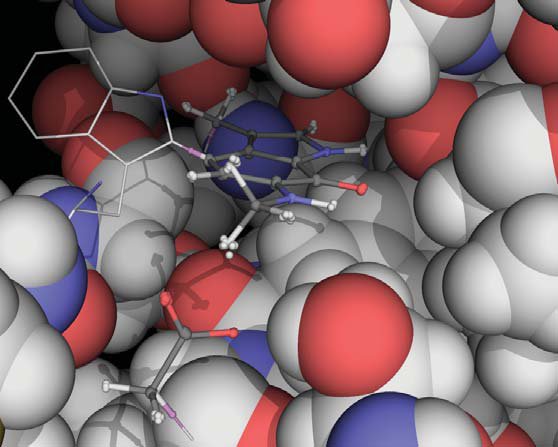
In the active site, the path integral method shows how individual atoms are modelled by clusters of beads, indicating that light atoms like hydrogen have larger quantum spreads