
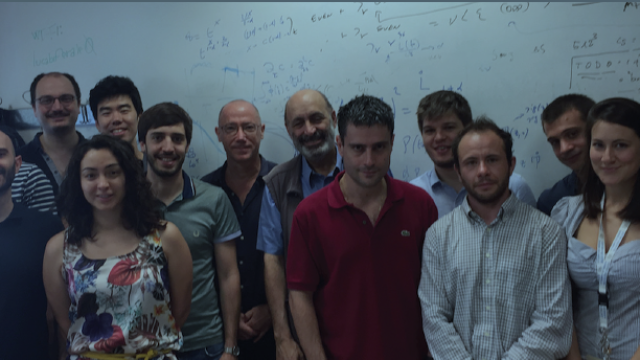
Using centuries old equations of fluid motion, supercomputers can be used to simulate turbulent flow in fine detail. But theoretical physicists are still unsure as to how these equations actually work. A group led by Professor Luca Biferale of the University of Rome Tor Vergata has been carrying out state-of-the-art simulations of turbulent flow under rotation, which are not only applicable to real life situations such as weather systems, but can also provide insight into the equations themselves.
What can you find in the air, on an aeroplane, or even deep inside your heart?
No, the answer isn’t love. It is, of course, turbulent flow – the chaotic and unpredictable movement of fluid through space and time. It has been causing physicists and mathematicians headaches for centuries, and remains one of the most important unsolved classical physics
problems out there.
“Turbulent flow is everywhere — inside blood vessels, in atmospheric weather systems, in the air moving through aeroplane engines — so naturally physicists are fascinated by it,” says Professor Luca Biferale of the University of Rome. The rules that describe the motion of fluids — the Navier-Stokes equations — have been known for over 200 years, yet, amazingly, they are still not fully understood. This leaves theoretical physicists in the curious position of being able to simulate systems of turbulent flows on computers without truly knowing how they work.
“We have these fantastic equations which describe the motion of fluids, but we cannot use them to predict the exact nature of turbulent flow. So instead, we plug these equations into supercomputers and carry out virtual experiments so that we can empirically observe the flow. This in turn allows us to probe our theoretical tools in ways we cannot do with real experiments in a laboratory.”
A group lead by Biferale has been coordinating the NewTURB project, which is using simulations to investigate turbulent flow under rotation. Understanding the dynamics of fluids under this condition has many applications due to the fact that the Earth spins on its axis as it orbits the sun. This means that the oceans, the atmosphere and the inner mantle of our planet are all subject to rotational force.
The problem with studying something as unwieldy as the movement of air, though, is that it is quite difficult to measure in fine detail in the lab. In fact, it is almost impossible. “This is where simulations come into their own,” says Biferale. “On a computer, you have more freedom than in a lab. For instance, we can look at the flow without boundaries, i.e. in a hypothetical infinite space, which in a lab of course is impossible. This helps to get rid of issues related to the movement of fluid being affected by being in a container.
Essentially, we can simplify the problem while still keeping the main physical ingredients, and then perform numerical experiments in this
idealized setup.”
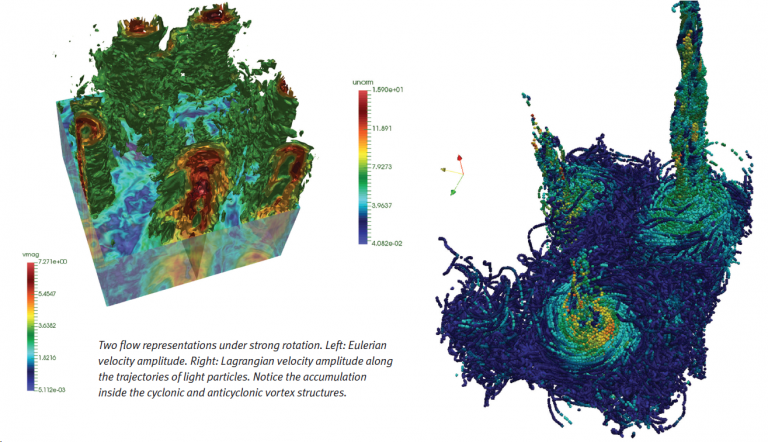
In the simulations, the researchers increased and increased the rotation rate in a turbulent flow to see what happened when the laws governing the motion of fluids were placed under extreme conditions. What they saw was that at some point, there was a transition in the flow, leading to the formation of large tornado-like structures oriented in the direction of the rotation. “What was interesting is that these
structures only appeared after a very specific level of rotation was reached,” says Biferale. “If the rotation was not strong enough, there was no sign of them.”
After studying how the flow changed during the formation of these tornado-like structures, Biferale and his colleagues looked into another related issue. Turbulence can be studied in two ways. A Eulerian approach looks at a fixed space and observes how fluid flows through it – much like sitting on a riverbank and watching the water flow past a fixed point. A Lagrangian approach looks at an individual object being moved through space and time by the flow – like watching a leaf being taken downstream by the current.
So, after having looked at the formation of the tornado-like structures in their initial flow simulations – the Eulerian approach – the
researchers then sought to look at how something might be transported by them – the Lagrangian approach. “This is really just another way of looking at the same problem, which tells us even more about this type of flow,” says Biferale. “One application of these Lagrangian simulations is that it can tell us what happens to contaminants if they enter the atmosphere and are transported by these kinds of flow structures.” Biferale’s group are world leaders in numerical simulations of Lagrangian turbulence, and the supercomputing power provided by PRACE has allowed them to look at billions of particles as they flow through space and time, providing quantitative information on turbulent processes at unprecedented levels. The NewTURB project is the first to have ever studied Lagrangian turbulence in a rotating flow, and the results were recently published in the Physical Review X.
One question you might ask about this type of research: if the simulations are being carried out in such idealized conditions, are they really useful when applied to real life applications? “I always answer this question in two ways,” says Biferale. “Firstly, I tell people – this research is not useful at all! We are looking to carry out basic research and if it were immediately useful, then it would no longer be basic research.
Of course, I am half-joking when I say that, because our research is indeed very useful in some ways. In all applied situations of turbulence, you will always have boundaries, unlike in our research. But, although this does affect the flow, once you move just a little bit away from the boundary you start to see the same structures as in our idealised conditions. This is known as the universality of turbulence – the fact that we see the same structures emerging in all turbulent flows. If it were the case that slight changes in boundary conditions or energy injection caused hugely different flows, only engineers would be interested. But because we see these robust similarities, us theoretical physicists can say things about flows in any situation with a certain degree of accuracy.
What I find really interesting is that although we know this universality exists, we cannot prove it from the equations of motion. We can empirically observe this universality in our simulations, and even superimpose it over data taken from rotating flows observed in labs, but we cannot prove from the equations of motion that all turbulent flows behave in the same way to some extent. And it is this, as theoretical physicists, that we are slowly but surely trying to do.”
For more information see www.fisica.uniroma2.it/~biferale
Resources awarded by PRACE: This project was awarded 55 000 000 core hours on Fermi hosted by CINECA, Italy
Publications: https://journals.aps.org/prx/abstract/10.1103/PhysRevX.6.041036
This article was first published on www.prace-ri.eu on 5 November 2017