Understanding the origins of our universe is the foundation to understanding its future. Professor Frederic Bournaud and his international team of collaborators are leveraging the power of PRACE HPC resources in their pioneering work using numerical simulations to explain the intensity of star formation, a fundamental building block in understanding how galaxies are formed.
Researchers led by Prof. Frederic Bournaud of the Institut de Recherche sur les Lois Fondamentales de l’Univers (Institute for the Research into the Fundamental Laws of the Universe), a part of the CEA, the French government-funded technological research organization for Atomic Energy and Alternative Energies, are doing pioneering work in understanding star formation and its magnitude in colliding galaxies.
Understanding galaxy formation is severely limited by our lack of knowledge about star formation. We know that star formation is governed by the chaotic parsec-scale physics of the interstellar medium (ISM). Through observation, we know that when galaxies collide star bursts occur. But the link between the small-scale physics of star formation on galactic scales is still poorly understood. Prof. Bournaud and his colleagues believe that by modelling the behaviour of gases in galaxies, we can learn what is behind the tremendous star bursts following the collision of galaxies.
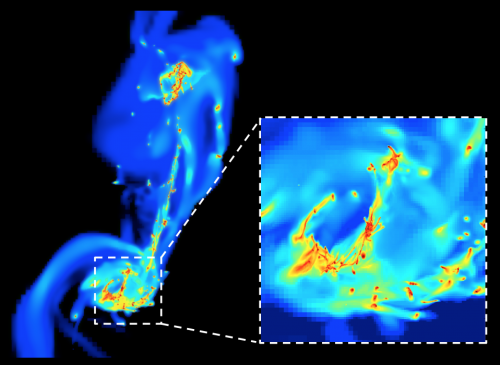
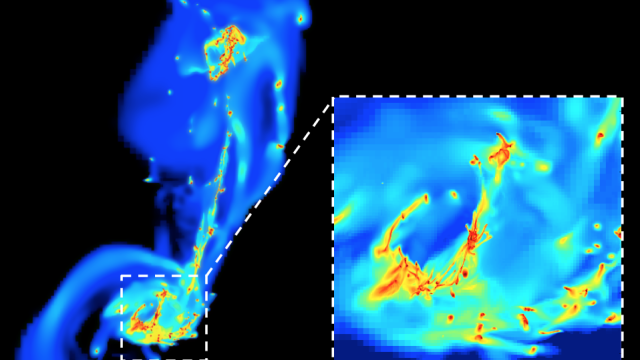
This image shows the structure of interstellar gas in two colliding galaxies (left), with a zoom into the central parts of one of the involved galaxies (right). The galactic encounter has strongly increased the turbulent fragmentation of the gas, which initially had densities of 1-10 atoms per cm^3 (blue colors) and fragmented into turbulent clouds of more than 10^6 atoms per cm^3 (red spots on the image). The collapse of these dense clouds creates new stars at a considerable rate, and the pair of galaxies experiences a so-called “starburst”.
Galaxy formation, however, often proceeds in violent phases during which galaxies accrete mass very rapidly, collide and merge with each other – not just in calm isolation as in the case of work done in studying the Milky Way. The properties of ISM turbulence and ISM structures are likely different in such systems. Observationally, these systems often undergo strong « bursts » of very rapid star formation. But whether these bursts are only a large-scale property with a universal efficiency of star formation on small scales, or whether there could be locally-enhanced of locally-suppressed star formation in molecular clouds at some intermediate scale, is still unknown.
The team began to explore the possibility that the conversion of low-density galaxy-wide gas reservoirs into molecular clouds and dense substructures may be a non-universal process. Based on the fact that the connection between the actual formation of individual stars on small scales and the properties of star formation in entire molecular clouds and entire galaxies is governed by the structure and properties of the Interstellar Medium (ISM), the team used numerical simulations of galaxies to study the properties of the ISM in various conditions. Only recently simulations became capable of accurately describing the global structure and dynamics of galaxies and resolving supersonic turbulence in the cold phases of the ISM at the same time. Simulations of this type typically require very high resolution (around one parsec) in boxes of tens of kiloparsecs.
Prof. Bournaud and his team utilised over 8 million core hours on the SuperMUC Tier-0 supercomputer at the Leibniz Supercomputing Centre (LRZ) in Garching, Germany to model ISM physics and star formation in such « extreme » events with bursts of star formation. Using hydrodynamical simulations, the researchers proposed a physical explanation for the enhancement of star formation activity in galaxy mergers. They discovered that global SFR evolution reaches numerical convergence at parsec-scale resolution and that the rise of the gas mass fraction in compressive tides in extended volumes during the galactic collisions pumps turbulence into the ISM. This creates an imbalance in the equipartition between compressive and solenoidal turbulence modes and verified that this turbulence is not primarily driven by feedback. The compressive turbulence overcomes the regulating, stabilizing effect of turbulence, and generates an excess of dense gas. This excess translates into enhanced star formation activity and drives the merger to the starburst regime in the Schmidt-Kennicutt diagram. From the gravitational and tidal trigger to the ignition of starburst, the full sequence takes ∼ 10 – 30 million years.
These finding were based on a simulation of the Antennae galaxies. Obviously, in other interacting systems, the quantitative results we presented here are modulated by the parameters of the galaxies (shape of the halo, mass ratio, etc.) and by the details of their interaction (spin-orbit coupling, impact parameter, orbital eccentricity, etc.). However, the ubiquity of compressive tides in mergers has been previously demonstrated by Renaud et al. (2009), which suggest that the triggers and physical processes mentioned above exist in many mergers.
While this work only accounted for integrated properties of the tides, turbulence and star formation, a study of the spatial distribution in the galaxies as well as the propagation of these phenomena is currently ongoing. This work will aim to show that the locations in space and time of the compressive tides, compressive turbulence and star forming regions coincide.
The results that Prof. Bournaud and his colleagues published in April 2014 represent a major milestone in understanding the link between star formation and galaxy evolution. In addition to probing the « normal », isolated phases of star formation with the ongoing model of a Milky Way-type galaxy, this is a breakthrough toward the ability to probe « extreme » modes where the ISM is highly perturbed by tidal interactions and large scale shocks. This process is best observed and modelled for nearby galaxies, but may be even more important to understand the early phases of galaxy formation in the distant universe.