
Together, dark matter and dark energy dominate the nature of the universe — yet the phenomena have largely remained a mystery to science. Soon, the Euclid mission will set out to map dark matter and unravel the first physical properties of dark energy. The effort is supported by a giant universe simulation performed with PRACE resources that provides the largest catalogue of mock galaxies ever built.
Among the most puzzling mysteries of modern physics are the exact natures of dark matter and dark energy. While “ordinary” visible matter — baryonic matter in technical terms — accounts for only 4 percent of the matter of today’s universe, much more, namely 28 percent, is made up of the hitherto invisible dark matter. What exactly dark matter consists of, however, is still unclear. But its extent in the universe has been determined rather accurately by the Planck mission. Launched in 2009, the Planck telescope recorded data on the cosmic microwave background radiation, which, in turn, allowed scientists to deduce the total amount of dark matter.
The era of dark energy
Another phenomenon shaping the universe is dark energy, which is understood as a force that acts conversely to gravitation and is causing the acceleration of the universe’s expansion that we can observe. It is thought to represent the main part of the matter and energy content of today’s universe — approximately 70 percent. Together, dark matter and dark energy control the universe’s past, present, and future evolution.
“While at the birth of the universe other forces were dominant, dark energy has gradually become the most influential phenomenon on the evolution of the universe, and with the universe expanding further, its influence is increasing exponentially”, says Joachim Stadel, a professor at the Institute for Computational Science at the University of Zurich. His team has now performed a giant simulation of the universe to support the ESA Euclid mission that has the aim to shed some light on dark energy.

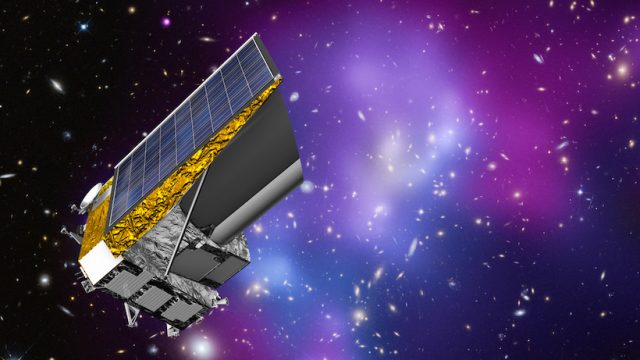
An illustration of the Euclid spacecraft and telescope. During its operation, the solar panels (on the left) will always point towards the sun to provide the spacecraft with power; at the same time, the sunshield will shade the instrument-carrying module (on the right) from the sun’s intense radiation; all the while the telescope will scan the sky to observe billions of distant galaxies. Euclid is about 4.5 metres tall and 3.1 metres in width.
Image credit: Wikimedia commons/ESA/C. Carreau
The Euclid telescope, which is scheduled to be launched by the end of 2022, will map the entire universe by recording the positions and masses of its galaxies and capturing the distribution of dark matter by measuring gravitational lensing — a light distortion of galaxies that arises from the gravitation of dark matter. Dark matter distribution, in turn, relates information about the physical properties of dark energy. The mission’s main goal is to better understand how dark energy drives the acceleration of the universe’s expansion, and the scientists involved particularly aim to determine the very first physical parameters with which to describe dark energy.

Gravitational lensing, a light distortion phenomenon that is caused by the gravitation of dark matter, observed by the Hubble telescope: The gravity of a luminous red galaxy has gravitationally distorted the light from a much more distant blue galaxy. Since the blue galaxy is aligned precisely behind the red one, its light appears as a nearly complete ring.
Image credit: ESA/Hubble
An interpreter of information
Even before the satellite’s launch, its future measurements need to be predicted to ensure that the aim is, in fact, realistic and to facilitate the interpretation of the data. This is where Stadel and his co-workers’ giant universe simulation comes in: Building on the team’s previous simulation using 2 trillion particles, their new simulation included over 4 trillion particles, achieving the largest mock galaxy catalogue ever assembled. “From this mock universe, colleagues will simulate what Euclid would measure and compare the outcome back to the mock universe — to determine error margins and improve data analysis,” says Stadel.
For this to be possible, an enormous area of space needed to be simulated, namely the considerable depth of the universe that Euclid will scan within the planned six years of measurements. And, as Stadel explains, it required a certain resolution to allow scientist to draw connections between galaxies and dark matter. For instance, a galaxy the size of the Milky Way must be represented by at least 1,000 particles. “With our Euclid simulation,” he says, “we are just reaching these thresholds.”
This artist’s impression shows how gravitational lensing by a galaxy magnifies, brightens, and distorts the appearance of a remote galaxy far behind. The effect is caused by the gravitation of dark matter and is one of the observed indications of its existence.
Video credit: ESO
Elusive neutrinos
In addition, for the first time in such a gigantic simulation, massive neutrinos are included, which is important since Euclid is expected to be the first satellite able to measure neutrinos’ masses. This had been difficult so far since neutrinos are a peculiar sort — they exist as different types with different masses that are unknown (only the differences in mass between the various types have been determined), and they do not react easily to matter.
“Neutrinos do not have a huge impact on the distribution of matter,” says Stadel, but they still have a significant influence on some of the future Euclid measurements. For instance, neutrinos cause a 15 percent shift in the matter power spectrum, a function which describes the density contrast of the universe and that will be determined by Euclid’s measurements. “Euclid will detect the power spectrum within a margin of 1 percent accuracy, which means that we had to mirror the same accuracy in the simulation.”
From simulation to emulation
While the simulated mock universe is being used to prepare for the satellite’s launch, additional tools, namely emulators, will be needed to evaluate the data once the telescope starts its measurements. Emulators are a form of machine learning application, and they are trained with simulation runs. “The emulators provide a fast way to connect the insights and correlations deduced from the simulation to the Euclid data,” Stadel explains. He and his team developed and recently extended such a tool, EuclidEmulator, that computes the dependence of cosmological parameters on the matter power spectrum — a complex, non-linear relationship. The updated version, EuclidEmulator2, does the same using an improved dynamical representation of dark energy and with the inclusion of massive neutrinos.
EuclidEmulator2 is, in fact, the first emulator to represent the matter power spectrum with 1 percent accuracy. “It provides a way to identify the effect of changes of certain parameters on the power spectrum,” says Stadel. For instance, scientist can use the tool to calculate the probability distribution of a certain parameter, or to investigate how parameters need to be changed to better reproduce reality. Taken together, simulations, emulators and the Euclid data are expected to enable scientists to learn more and piece together the puzzle around the elusive driving forces of our universe — dark matter and, especially, the mysterious dark energy.
Project title: Simulating the Euclid Universe
Resources awarded:
17th call: 136 million core hours on Piz Daint hosted by CSCS, Switzerland
Research field: Universe Sciences
References
M. Knabenhans et al.: Euclid preparation: IX. EuclidEmulator2 – power spectrum emulation with massive neutrinos and self-consistent dark energy perturbations. Mon. Notices Royal Astron. Soc. (2021). DOI: https://doi.org/10.1093/mnras/stab1366
M. Knabenhans, J. Stadel, S. Marelli, D. Potter, R. Teyssier, L. Legrand, A. Schneider, B. Sudret, L. Blot, S. Awan, C. Burigana, C.S. Carvalho, H. Kurki-Suonio and G. Sirri: Euclid preparation: II. The EUCLIDEMULATOR – a tool to compute the cosmology dependence of the nonlinear matter power spectrum. Mon. Notices Royal Astron. Soc. (2019). DOI: https://doi.org/10.1093/mnras/stz197
D. Potter, J. Stadel and R. Teyssier: PKDGRAV3: beyond trillion particle cosmological simulations for the next era of galaxy surveys. Comput. Astrophys (2017). DOI: https://doi.org/10.1186/s40668-017-0021-1
Contact
For all questions about PRACE communications, promotional and press materials, social media, and publications: communication@prace-ri.eu