
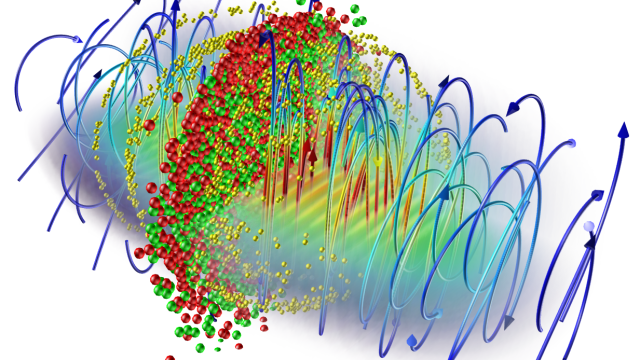
Leveraging the petascale computing power of SuperMUC, an international team of researchers performed 2D/3D simulations of laser absorption in dense electron-positron plasmas self-consitently created via electromagnetic cascades. Their numerical findings provide a set of laser parameters to optimize the convertion of optical photons into pairs and gamma rays allowing to mimick extreme astrophysical scenarios and their radiation signatures.
Relativistic electron-positron pair plasmas are tightly related to extreme astrophysical objects such as pulsar magnetospheres or gamma-ray bursts. Due to the inherent difficulties of studying these remote objects it is extremely desirable to study dense pair plasmas in the laboratory, both for fundamental purposes and astrophysical applications. The recent spectacular rise in laser intensities accompanied by the ongoing construction of new laser facilities such as ELI [1] or the Vulcan 20 PW will place intensities above 1023W/cm2 within reach. The magnitude of these lasers electromagnetic fields overlaps with the estimated fields of milliseconds pulsars. Producing pair plasmas in ultra strong fields may demonstrate that we can mimic the conditions appropriate to these astrophysical environments in terrestrial laboratories. The pair creation in such energy density environments is caused by the decay of gamma rays in intense fields. This process usually leads to quantum electrodynamics (QED) cascades, as the pairs created re-emit hard photons that decay anew in pairs, eventually resulting in electron-positron-photon plasmas. A configuration was recently proposed, comprising two counter propagating laser pulses with some seed electrons in the interaction region to initiate the cascade. The development of a cascade is shown in Fig.1 for two colliding laser. The conditions to achieve substantial laser absorption were investigated and the ratio between the absorption time and the pulse duration is the relevant parameter for the laser depletion [2,3,4]. A significant laser energy conversion to hard photons can be achieved at lower intensities than when using four colliding lasers instead of two. Fig. 2 shows the electric field structure of a standing wave formed by 4 lasers as well as the shape of the density distribution of the created plasma.
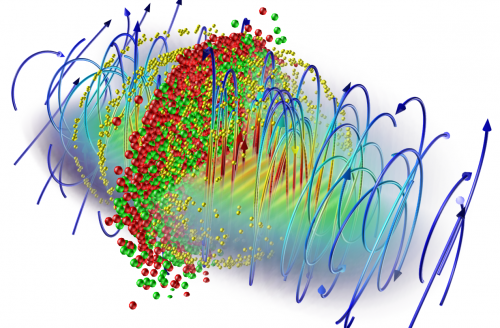
Figure 1: 3D simulation of a 2-lasers QED cascade showing the electric field lines (blue arrows) and the pairs and photons (respectively in red, green, and yellow).
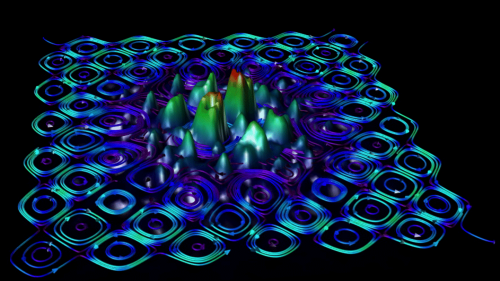
Figure 2: 2D simulations of a 4-lasers QED cascade showing electric field vortices (colored lines) and pair density.
It is known that the radiation emitted by relativistic particles can change in the presence of sufficiently strong fields. Quantum effects then start to play a role and emission of hard photons becomes significant at fields on the order of the Schwinger field in the particle rest frame. Several scenarios were studied in a setup where electrons were counter-propagating with a circularly polarized laser pulse and with a linearly polarized laser pulse. Using increasing intensities it was possible to observe the changes in the spectrum due to recoil and associated quantum corrections. An example of spectra obtained for such simulations is shown in Figure 1. It depicts the spectrum over a line for the collision between an ultra-relativistic electron and a circularly polarized laser. Quantum corrections associated with the change in emission process lead to a reduction of energy radiated at higher frequencies [5].
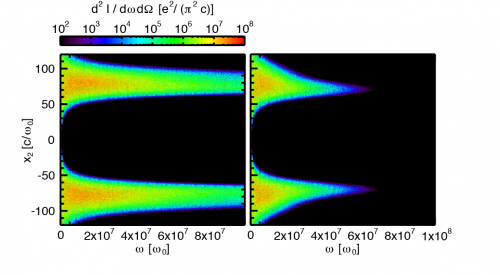
Figure 3: Left / right scattering spectra represent the results without / with quantum corrections.

GoLP/IPFN, Instituto Superior Técnico, Lisboa (Portugal)
Principal Investigator: Thomas Grismayer
HPC Platform: SuperMUC of LRZ
References
[1] http://www.eli-laser.eu
[2] M. Vranic et al., Comp Phys Comm 191, 65-73 (2015)
[3] T. Grismayer et al., Submitted to Physical Review Letters, Arxiv: 1511.07503 (2015)
[4] T. Grismayer et al., Submitted to Physics of Plasmas, Arxiv: 1512.05174 (2015)
[5] J. Martins et al., PPCF 58, 014035 (2016)
This is a reprint of the article published on the GCS Gauss Center for Supercomputing website
All images © Thomas Grismayer/Instituto Superior Tecnico Lisboa, Portugal