
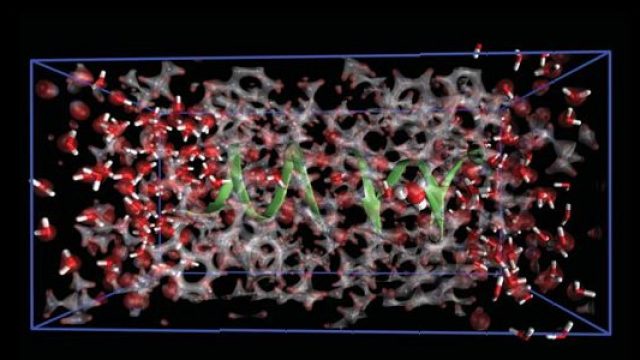
Paolo Carloni’s research group from German Research School for Simulation Sciences in Jülich was among the first projects which were granted access to the PRACE resources. Carloni’s group was granted for 48 758 784 core-hours on the JUGENE IBM BlueGene/P in the PRACE first regular call. The allocation is for one year ranging from November 2010 to October 2011.
Carloni’s research group currently includes thirteen members. “At the moment we have a full professor, four research assistants and eight doctoral candidates”, tells Paolo Carloni, Emiliano Ippoliti, Jens Dreyer and Chao Zhang, members of the research group.
“Our computational biophysics team is highly international with members from six different countries, ranging from Australia to Italy. The scientific backgrounds are also diverse, with a mixture of physicists, chemists and biologists. This diversity is a great benefit in facing the challenges of the fascinating, interdisciplinary subject, molecular biophysics”, they continue.
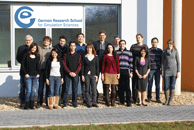
Left: A group of researchers from the German Research School for Simulation Sciences in Jülich are one of the first research groups to use the PRACE resources. (@ GRS – P. Carloni, E. Ippoliti, J. Dreyer & C. Zhang)
Proton transport in ion channel
The project is using ab initio molecular dynamics to study proton transport in a biological channel. Biological ion channels are pore-forming transmembrane proteins which selectively regulate transport of ions in and out of every living cell. Membrane proteins are crucial for cell function and their derangement is involved in many diseases, including heart attack. There are a number of diseases that involve ion channels, including diseases such as cystic fibrosis, epileptic seizure, diabetes and migraine.
“In this project we are looking at the mechanism of proton transport in ion channel Gramicidin A. This channel is well studied in the laboratory, allowing our results to be directly compared with experiments”, they explain.
Ab initio molecular dynamics methods have proven to be an invaluable tool in chemistry and physics. The method is very compute-intensive method and requires huge computational resources. With the PRACE Tier-0 resources it is now possible for Carloni’s group to study this problem using ab initio molecular dynamics simulation.
“Access to this huge computational power, through PRACE, allows us to push the limits of ab initio molecular dynamics to perform large-scale simulations of a biological system of sufficently large size that the results can directly be compared to results from a laboratory. The ab initio method allows us to include electronic polarization and charge transfer effects in the simulation that are required to study the delocalized nature of the proton migration”, they clarify.These simulations done with the PRACE resources will give answers e.g. to the viral replication of the dreaded H1N1 swine flu, which was a pandemic in 2009.
“Our study of proton transport in Gramicidin A channel will help us better understand the mechanism of proton conduction in membrane channels generally. A recent example of why this understanding is important is the crucial role influenza-A proton-channel M2 plays in the viral replication of H1N1 swine flu. We will gain new insight into the elementary steps of how a proton transfers through a transmembrane ion channel. This involves a detailed understanding of the sequence of alternating hydrogen and chemical bond breaking and making processes, the interplay of the electrostatic interactions imposed by the protein, the membrane, the surrounding water molecules and the transmembrane potential”, they explain.
The final results from this study will be ready after the allocation time on JUGENE ends in October 2011.“Without the PRACE resources the project would be impossible at this time”, they conclude.
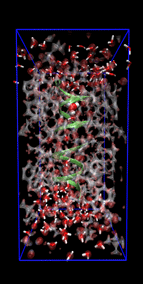
The simulation box of Gramicidin A channel (@ GRS – P. Carloni, E. Ippoliti, J. Dreyer & C. Zhang)