
It is only by using high-performance computers that Dr Gabriel Wlazłowski of the Warsaw University of Technology has been able to advance our understanding of neutron stars and how quantum vortices colliding inside them are responsible for speeding up of their rotational frequency. He believes this work is just starting and with the advent of exascale systems much larger simulations will be possible
It is hard to overstate the influence of quantum mechanics on our understanding of the world – it rewrote rules that had stood for over 200 years and is the foundation upon which much of our knowledge in science and technology today is built. But its oversized presence belies its subtle nature. Its more curious effects manifest almost exclusively at the atomic level and, at the level that we experience the world, barely describes the world any differently than classical physics.
However, there are a few instances where the strangeness of quantum mechanical effects can be observed with the naked eye. A superfluid is an exotic state of matter that lacks viscosity, the internal friction that allows normal fluids to resist and cause motion. This lack of viscosity bestows all sorts of weird properties upon superfluids, allowing them to climb up the walls of their containers or even pass through thin solid materials.
Dr Gabriel Wlazłowski of the Warsaw University of Technology has been developing a version of density functional theory that can be used to accurately describe strongly interacting systems such as superfluids. A recent PRACE project aimed to test this method in the context of two physical systems: ultracold atomic gases and neutron star crusts. Although seemingly very different, both are described by remarkably similar microscopic theories and share similar superfluid properties.

“When many quantum vortices reorganise simultaneously in this giant mass of superfluid, it manifests at the macroscopic level as this increase in rotational speed. In the future, we hope to be able to studythese systems in more detail using the methods we have been refining in this project”
Gabriel Wlazłowski
Neutron stars – the collapsed cores of massive giant superstars that, aside from black holes, are the densest known stellar objects in the universe – are one of the targets for Wlazłowski’s methods. Due to the impossibility of studying such entities experimentally, much of what is known about neutron stars today has been found through simulations. Some phenomena recently observed in neutron stars have led some to believe that they may be superfluid, but in order to develop the computational methods to study this, they must first be tested on smaller, known systems.
Ultracold atomic gases that, like many suspect neutron stars to be on the inside, are superfluid. However, unlike neutron stars, it is possible to study ultracold atomic gases in a laboratory setting. Recent work from experimentalists looked at rotating and strongly-interacting gas in its superfluid state, cooled down to nanokelvin temperatures just above absolute zero. Normally when a fluid is put into rotation, like when it is stirred, it ceases to rotate due to angular momentum transferred via viscosity, which can be simply understood as a kind of internal friction. Superfluids have zero viscosity, so angular momentum is instead carried by what are known as quantum vortices. They can rotate forever. Wlazłowski has been trying to replicate the quantum vortices measured in experiments to validate his computational methods.
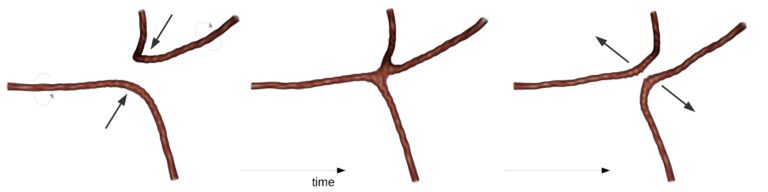
Collision of two quantum vortices. In the collision, the vortices approach each other, merge locally and reconnect, leading to a new topological configuration. Although the phenomenon is a very nonlinear process, it turns out that its dynamics is universal close to the reconnection point. Having access to Tier-0 granted by PRACE, we confirmed that it proceeds in the same way in various systems, including strongly and weakly interacting Fermi superfluids, Bose-Einstein condensates, ordinary and exotic superfluids.
Wlazłowski’s simulations have been able to show in great detail the process of quantum vortices colliding, a process known as reconnection. It is believed that quantum vortices are responsible for a phenomenon observed in neutron stars in which their rotational frequency periodically speeds up. “There is a hypothesised model that explains this phenomenon in which the interior of the neutron star is presumed to be a superfluid,” says Wlazłowski. “When many quantum vortices reorganise simultaneously in this giant mass of superfluid, it manifests at the macroscopic level as this increase in rotational speed. In the future, we hope to be able to studythese systems in more detail using the methods we have been refining in this project.”
As well as trying to replicate experimental data using their methods, Wlazłowski and his team have also used their PRACE allocation to work the other way, making predictions that can then be checked by experimental teams. One of the predictions they have made is the existence of a novel superfluid state in which small pockets of the fluid have much higher density. Such states are referred to as supersolids. Historically, the development of density functional theory has strongly correlated with development of high-performance computing. It took teraflop performance for the theory to become useful for quantum chemistry and solid-state physics applications. To study strongly interacting systems such as superfluids, the computational need is a thousand times greater, but this has now become possible with current Tier-0 systems such as Piz Daint, on which Wlazłowski’s work was carried out. “Our work in this project is really just the beginning,” he says. “We can now see that it is possible to apply this method on such systems, so we can now start working on refining the methods so we can trust the results, and also begin planning for the possibilities of exascale systems. Right now, we simulate systems at a much smaller scale than experimental set-ups but, with the dawn of exascale systems, we should be able to simulate them directly.”

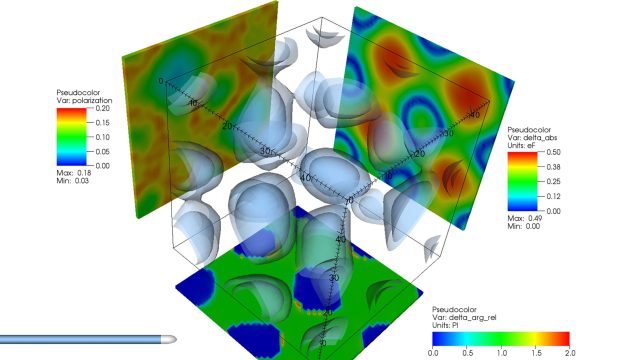
Exotic state in Fermionic superfluid: the spin-imbalanced gas of strongly interacting particles spontaneously creates localized impurities. The characteristic feature is the presence of the nodal surface (blue contours) of the pairing field at which the order parameter changes its phase by π (delta_arg_rel panel). The spin polarization reaches the maximum in the vicinity of the nodal surface (see polarization panel). The impurities, we dubbed ferrons, can form various structures, in the given example they organize similarly to ions in solid-state. The existence of ferrons has been predicted numerically and awaits for experimental conformation.
Wlazłowski’s team has published a number of papers based on this work using PRACE resources that he believes will showcase the ability of high-performance computing to address such topics to the wider scientific community.
“In the long term, we want to start building a community of people gathered around these methods,” he says. “We have released our codes in the form of open-source software, and eventually we would like to create a toolkit available to all that will be designed specifically for studying the interiors of neutron stars.”
This article was also published in PRACE Digest 2021.
More information:
http://wlazlowski.fizyka.pw.edu.pl
Resources awarded:
This project was awarded 85 300 000 core hours on Piz Daint, hosted by CSCS, Switzerland.
Contact
For all questions about PRACE communications, promotional and press materials, social media, and publications: communication@prace-ri.eu