
Dr Mert Gur of Istanbul Technical University is studying the tiny cellular engines known as dyneins, motor proteins that convert chemical energy to drive movement in our cells. By modelling their thermodynamic cycles, he hopes to provide crucial information that will improve our understanding of diseases like Alzheimer’s and cancer, as well as opening up new possibilities in nanotechnology
If you’ve ever found yourself getting frustrated at your train not turning up on time, you might be annoyed to hear that the inside of your own cells are probably better connected than your local town or city. Microscopic ‘railway’ systems made up of tiny tracks called microtubules – each of which are just 25 nanometres wide – connect all of the important destinations within our cells. Cargo can be transported along these tracks to ensure cellular functions and homeostasis are maintained. But if microtubules are the cellular tracks, what are the cellular trains?
The answer is motor proteins, tiny cellular engines that convert chemical energy stored in ATP to drive movement. With a background in mechanical engineering, Dr Mert Gur of Istanbul Technical University found himself drawn to working out how these cellular dynamos work. “Motor proteins are fascinating to me because they function exactly like a car engine,” he says. “Much like a car, they take a fuel – ATP – and break bonds in it to release chemical energy. This is then converted into mechanical energy, which can be used to transport cargo, move flagella, or prepare the cell for mitosis.”
To understand how these biomolecular nanomachines work, it is useful to first imagine how more familiar machines work. “When we look at a device such as a car engine, we see that it operates on a thermodynamic cycle,” says Gur. “This means that it starts at one point, does whatever it needs to do, comes back to the same point, then repeats. Revolutions per minute of a car engine is in fact therefore a measure of the number of thermodynamic cycles happening per minute. Proteins are the same – they start at one point, do their function, come back, then do it again and again.”

“This is a significant contribution to the field as dynein’s mechano-chemical cycle has not been simulated at atomistic detail before.”
Mert Gur
Gur has been leading a PRACE project, which is performed in collaboration with Ahmet Yıldız of UC Berkeley (USA) and Andrew Carter of Medical Research Council (UK), with the aim of modelling the thermodynamic cycles of a family of motor proteins called dyneins. Interest in these molecules lies not only in their role in disease – problems with dyneins are linked to both developmental and neurological disorders– but also their potential for the field of nanotechnology, which as yet does not contain within its arsenal molecules that are capable of functioning as engines, converting chemical energy into mechanical motion.
To understand exactly how dyneins work, Gur uses molecular dynamics simulations to fill in the gaps in experimental knowledge. “When looking at how a protein functions, experiments can only get you so far,” he explains. “They can provide you with an atomic structure of the protein, but what you actually get is the protein frozen at one point along the thermodynamic cycle.
“It is possible to take a number of these snapshots to deduce how the protein might work, but it is not possible to experimentally capture how the protein gets from one point to another at atomistic detail. What molecular dynamic simulations do is to provide the link that shows the dynamic transition of a protein from one structural state to another.”
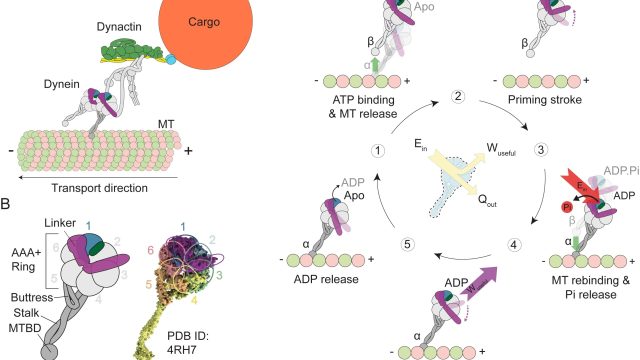
The best way to describe the way dyneins move along microtubules is “walking”. Two monomer legs connected by a linker domain move one after the other, attaching and reattaching further along the microtubule to make forward progress. The movement is powered by the ATP hydrolysis cycle. ATP binding to the dynein causes its release from the microtubule and ATP hydrolysis triggers a conformational change in the linker domain (called a priming stroke), which pushes dynein in the forward direction. After this, dynein rebinds to the microtubule, and releases the inorganic phosphate. Subsequently, the linker moves back to its original position, and this generates the force-generating power stroke that enables dynein to pull the cargo in the forward direction.

Dynein structure and mechanochemical cycle. A) Dynein pulling cargo via stepping along the MT. B) Structure and domain separation of each DHC. C) The mechanochemical cycle of the DHC. Linker undergoes ATP dependent conformational changes and generates force and motility, synchronized with MT binding/unbinding cycles.
Gur and his colleagues have successfully modelled the priming stroke of the linker, showing in detail the mechanism and energetics of this process. They have also modelled how dynein interacts with specific residues on tubulin and stably binds to microtubules. More recently, Gur has studied how microtubule-associated proteins (MAPs) regulate microtubule binding of dyneins. “Overall, we have been able to explore some of the most critical aspects of the thermodynamic cycle of dynein in this project,” says Gur. “This is a significant contribution to the field as dynein’s mechanochemical cycle has not been simulated at atomistic detail before.”
Gur is enthusiastic in describing the transformational effect of having access to Tier-0 resources to his research. “As a scientist working in a computational field, it’s like a dream having this amount of power at your fingertips,” he says. “Usually, you are in a position where the computational power available to you lags far behind the speed of your thoughts – it will take months to confirm just one idea through a simulation. With the resources provided by PRACE, this time was cut to a matter of days.
“As well as this, this project has opened up a number of new collaborations with other labs working on dyneins. There are not many people working in this particular field, as the system size of the dynein molecule solvated in water – around one million atoms – has meant that up until now, simulating it has been out of reach in terms of the limits of computational power today. Thanks to PRACE, we have carried out some of the first molecular dynamics simulations of these proteins, so I am grateful for this opportunity – it has been a great experience.”
This article was also published in PRACE Digest 2021.
More information:
https://gurlab.itu.edu.tr/en/
Resources awarded:
This project was awarded 48 400 000 core hours on Marconi100, hosted by CINECA, Italy
Contact
For all questions about PRACE communications, promotional and press materials, social media, and publications: communication@prace-ri.eu