
It is still questionable if vaccines reduce the transmission of COVID-19 — scientists at NCSA developed a plan B
Along with vaccines and drugs, ventilation techniques are becoming a powerful weapon against the coronavirus. These devices clean the air of indoor spaces, such as classrooms, disposing of the SARS-CoV-2 virus. However, to construct and install fitting devices, researchers must first learn, how viable the virus is and how air cleaning systems can get rid of it in suitable time — before infection occurs. Recently, scientists at NCSA in Bulgaria performed simulations to examine these factors and laid the groundwork for anti-virus ventilation systems for classroom and other populated indoor locations.
In the fight against COVID-19, air decontamination technologies are becoming increasingly popular for buses, classrooms, universities, offices, and airplanes. The method is simple and effective: It can physically destroy the SARS-CoV-2 virus, and reduce the risk of infection.
How to get virus-free air
Building on work of Japanese scientists and organisations performed on Fugaku, the world’s fastest supercomputer, researchers at the PRACE-affiliated National Centre for Supercomputing Applications (NCSA) in Bulgaria determined, how long droplets and aerosols loaded with virus linger in indoor spaces like classrooms. Their calculations examined specific conditions of indoor areas in detail, like the room’s size and presence of windows and doors.

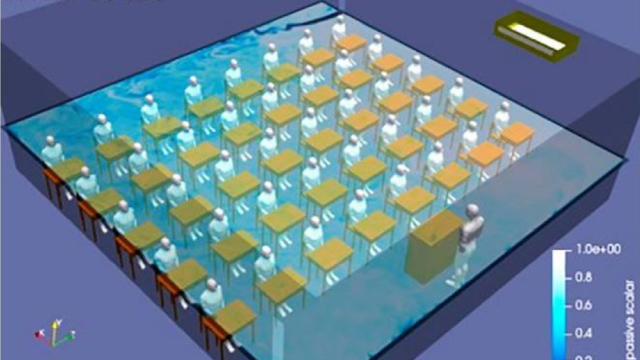
A simulation in a classroom by the supercomputer Fugaku, in which a window in the back of the room and a door in the front of the room are left open.
Image credit: Kyoto Institute of Technology, supported by Kobe University, Kajima Corp. and Riken Center for Computational Science
Based on these calculations, the NCSA scientists helped to develop a ventilation system that also includes air sterilisation by UV-light with the goal to reduce the concentration of viral aerosols to a level at which infection is fully prevented. The new ventilation system will be tailor-made for each room layout in schools and universities. NCSA will launch the project together with the Ministry of Education and Science and the Municipality of Sofia to be a part of Sofia’s and other Bulgarian cities’ initiatives to ensure a safe environment for children everywhere and at all times.
Go on to read the full story on the NCSA website.