
Binary neutron star mergers are unique astrophysical laboratories for studying gravity due to the additional electromagnetic signals they produce. Dr Carlos Palenzuela of the University of the Balearic Islands is investigating the huge amplification of the magnetic field in these mergers to understand why it occurs and what relevance this amplified magnetic field has to the dynamics of the system
When Einstein first published his theory of general relativity in 1915 and propelled our understanding of gravity beyond Newtonian physics, any calculations of the theory’s complex geometrical distortions of spacetime largely had to be done by hand. It would still be around half a century before the first supercomputers were built, marking the beginning of a paradigm shift in the way science is done.
Fast forward to today, and numerical relativity is one of the leading fields in supercomputing, pushing machines and software to their limits in the study of extreme astrophysical phenomena. Einstein’s theory has remained the key method for describing such events, and the power of supercomputers has turbocharged it as a tool in the modern age of physics. The recent detection of gravitational waves – ripples of warped spacetime predicted by Einstein that are emitted by cataclysmic events – has opened up a wealth of new research avenues. In August 2017, simultaneous observations of gravitational and electromagnetic waves from the merging of two neutron stars – the densest known entities in the universe aside from black holes – marked the very first instance of such a multi-messenger astronomical event being observed.
When two neutron stars orbit each other closely, gravity causes them to spiral inward towards each other. When the two stars meet, their merger leads to the formation of either a more massive neutron star, or a black hole. As well as gravitational waves, this merger can also amplify the internal magnetic field of the stars, up to an intensity that is trillions of times stronger than that of Earth in a matter of one or two milliseconds. These events are believed to create short gamma-ray bursts and kilonovae, both of which emit electromagnetic radiation that can be detected from Earth.

“What we proposed in this project was to use high resolution and high order numerical schemes alongside a technique called large eddy simulations which is especially designed to examine turbulent regimes”
Carlos Palenzuela
While gravitational waves can provide information about the masses and velocities at play in such an event, the additional electromagnetic signals produced make binary neutron star mergers unique astrophysical laboratories for studying gravity, plasma physics and dense matter under extreme conditions. Dr Carlos Palenzuela of the University of the Balearic Islands has been leading a PRACE project investigating the huge amplification of the magnetic field that occurs in these mergers.
There are some ideas of why this amplification happens. Kelvin-Helmholtz instabilities – the same phenomena that cause waves to appear when wind blows over the surface of water – manifest when the two neutron stars ripple together, inducing turbulence that can trigger the magnetic field amplification. However, the scales at which these initial instabilities occur are so small as to be almost impossible to accurately model using even the largest computing resources.
“What we proposed in this project was to use high resolution and high order numerical schemes alongside a technique called large eddy simulations which is especially designed to examine turbulent regimes,” says Palenzuela. “We hoped that the combination of these tools would allow us to capture the turbulent stage with enough accuracy to answer questions about why the magnetic field is amplified, what form the magnetic field takes in terms of shape and size, and what the relevance of this amplified magnetic field has to the dynamics of the system.”
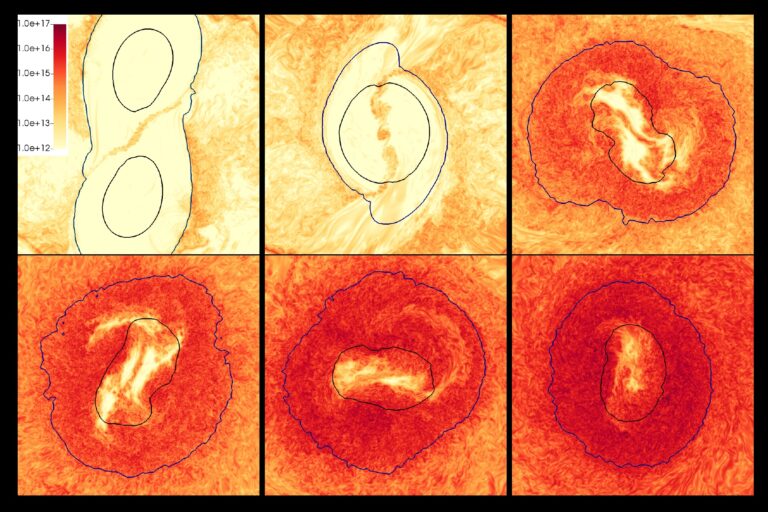
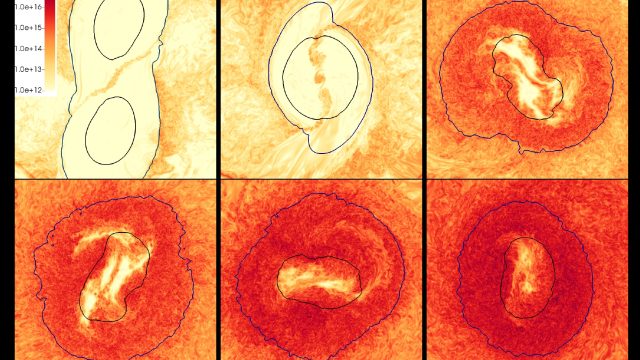
Merger of neutron stars. Snapshots at representative times displaying the magnetic field strength in Gauss, together with density isosurfaces representing the core and the envelope of the star. The amplification is driven mainly by the Kelvin-Helmholtz instability, that induces a turbulent stage which is accurately captured by using Large-Eddy Simulations with high resolution.
The simulations, which show few tens of milliseconds of a binary neutron star merger, examine a number of different variables within the system. “At the most basic level, we are computing the energies involved in the system: the rotational kinetic energy of the stars and the magnetic energy being produced, as well as the poloidal and toroidal components of the magnetic field. We also look at the entire star envelope – the larger area of gas that contains the whole system – to see how it grows over time.”
On top of this, Palenzuela’s team also examine the spectral density of the system, breaking down the distribution of energy into the various discrete frequencies produced. “In principle, from what we know about the physics, we expect the spectra to look a certain way,” he explains. “Exploring this aspect is the costliest part of our analysis, as it involves performing Fourier transformations in 3D with thousands of points in each direction. This part of our calculations has to be parallelized efficiently, as there are no machines today that have enough memory to do it directly.”
Through the past decades, a number of codes have been developed – with varying degrees of success – for carrying out such simulations, mostly designed by physicists rather than computer engineers. “We decided to take a different approach, using a public infrastructure called SAMRAI developed by experts at the Livermore Laboratories in the USA that takes care of issues such as parallelization and scaling that, as physicists, we know little about.
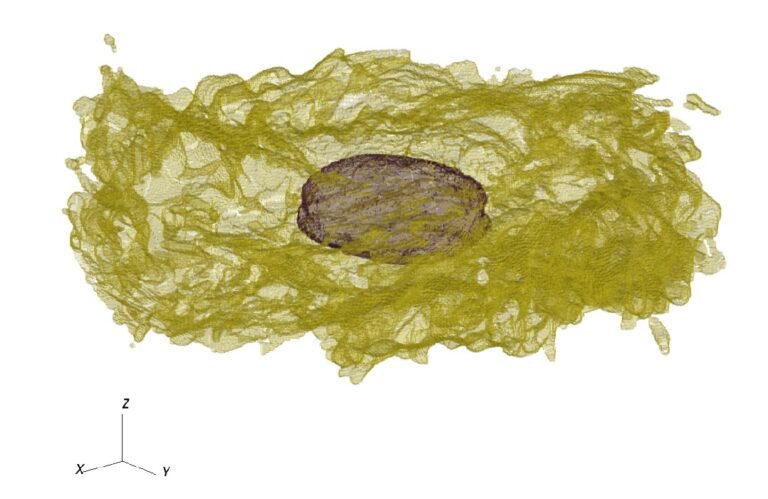
Merger of neutron stars. Density isosurfaces just after the merger of two neutron stars. The collision produces a rotating massive remnant that will eventually settle down into a spinning neutron star. The isosurfaces represent roughly the core and envelope of the remnant.
“Then, on top of that infrastructure, we run our own software called SIMFLOWNY that uses high order numerical schemes to solve the Einstein equations for describing compact objects such as neutron stars, as well as high-resolution shock-capturing methods for solving the magnetohydrodynamic equations, because the matter of the neutron star is described as a magnetized perfect fluid. By joining SAMRAI with this software of our own, we have created a new code called MHDUET.”
Preliminary results of the project have surprised some colleagues in the community, and the effects of the initial magnetic field on the final stage after the merger remains a disputed topic. As such, Palenzuela is now looking to carry out several similar simulations with different initial configurations to try and resolve the debate. “My impression is that because of the existence of this intermediate turbulent stage, all memory of the initial state of the system will be lost, making the final result independent of the initial magnetic field,” he says. “Of course, future work will also depend on what happens in our final high-resolution simulations. One option would be to continue the simulations beyond the first tens of milliseconds to reach the stage where the system collapses into a black hole. When this happens, an accretion disk of material forms around the black hole which is largely responsible for the appearance of jet outflows and short gamma ray bursts that power electromagnetic emissions detectable from Earth.”
This article was also published in PRACE Digest 2021.
More information:
http://iac3.uib.es/
Resources awarded:
This project was awarded 14 200 000 core hours on MareNostrum 4, hosted by BSC, Spain.
Contact
For all questions about PRACE communications, promotional and press materials, social media, and publications: communication@prace-ri.eu