
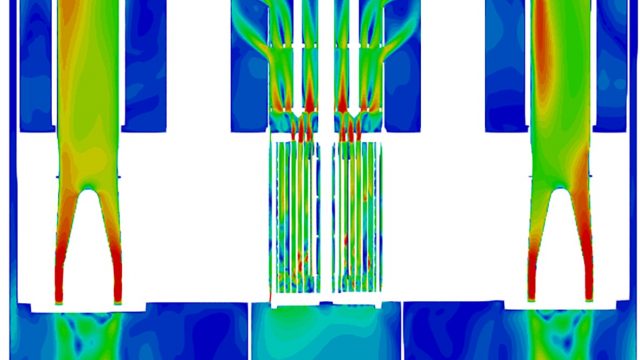
The next generation of nuclear reactors will generate huge amounts of heat at the core and so require new cooling methods. Dr Lilla Koloszar of the von Karman Institute for Fluid Dynamics has been testing methods that will aid the development of this new generation of reactors
The world of nuclear power has come a long way since Chicago Pile-1, the first ever nuclear reactor, was built in 1942 by Nobel Prize winner Enrico Fermi. Most of the reactors in use around the world today are what are known as Generation II reactors, while Generation III reactors are just now starting to come into operation. Naturally, forward-thinking researchers have already begun working on designs for Generation IV reactors, with the aim of improving safety, sustainability, efficiency, and cost.
The Belgian Nuclear Research Centre (SCK CEN) is currently designing a Generation IV reactor called MYRRHA which is cooled by a liquid metal called lead-bismuth eutectic (LBE). Dr Lilla Koloszar of the von Karman Institute for Fluid Dynamics specialises in studying the flow of such liquid metals, and has been leading a PRACE project in collaboration with SCK CEN in order to analyse the cooling system of this new nuclear reactor with high resolution in space and time. This will provide useful information to the nuclear researchers and engineers still working on the design of the reactor.
One of the main aims for the MYRRHA reactor is to be able to post-process the nuclear waste produced so that its half-life – a measure of how long the waste remains radioactive – is reduced from the order of hundreds of thousands of years to just hundreds of years. “In order to achieve this kind of reduction, you need a very compact core,” says Koloszar. “But with such a compact core you generate huge amounts of heat in a localised area which needs to be cooled efficiently, and this is impossible with conventional fluids. That is why we have to use liquid metals such as LBE.”

“Such a compact core generates huge amounts of heat in a localised area, which needs to be cooled efficiently”
Lilla Koloszar
Using liquid metals for cooling is a relatively new concept that at present is only used in Russian nuclear submarines at a much smaller scale than proposed here. “We are carrying out validation and verification of our computational fluid dynamics code by comparing it with the experimental data,” says Koloszar. “At this stage, a scaled-down version of the reactor called E-SCAPE that is one sixth of the full size of MYRRHA has been built. It is heated by electricity rather than by nuclear power, and in this project we are carrying out simulations that can be compared with readings from the model to help with validation of the code.”
Despite only being one sixth of the size of the proposed reactor, the experimental setup is still huge, with a diameter of over one metre. The pool of liquid metal used to cool it is extremely challenging to simulate accurately, and it is only thanks to HPC resources provided by PRACE that Koloszar’s team are able to simulate this pool both in operating conditions and in more transient conditions when the temperature of the coolant changes due to changes in the reactor output.
To do these simulations, a solver family called called myrrhaFoam was used, which is a variant of the open-source OpenFOAM simulation platform. These codes were developed through several years of collaboration between the von Karman Institute for Fluid Dynamics and SCK CEN. “We customised this code to be able to deal with liquid metals, because the general code had some shortcomings both from the nuclear side and from the liquid metal side,” says Koloszar.
After beginning the project, Koloszar and her team realised that the meshes needed to simulate the system were much larger than originally estimated. Despite this, they were able to achieve everything that they set out to do. “The support we received working on the Joliot Currie cluster hosted by GENCI at CEA was amazing,” she says. “We had many difficulties with compiling, and it is only thanks to this support that we were able to finish our work in time.”
With the E-SCAPE system, the flow of the fluid in the system could not be directly measured. Instead, measurements of the thermal field were taken, and these were then compared with the simulations to see if they matched up. “We were unsure if our code would be able to grasp the 3D nature of the flow, especially in what we call natural convection cases,” says Koloszar. “I must admit that the comparisons with the thermal field measurements were impressive. This showed that our simulations were almost certainly providing an accurate depiction of the flow field within E-SCAPE.”
The researchers are now involved in two ongoing European research projects that aim to investigate potential transient conditions and accidents in the MYRRHA reactor. “We hope to be able to continue using Tier-0 resources from PRACE for this further work, as simulations of transient conditions will be even more demanding than those performed in this project.”
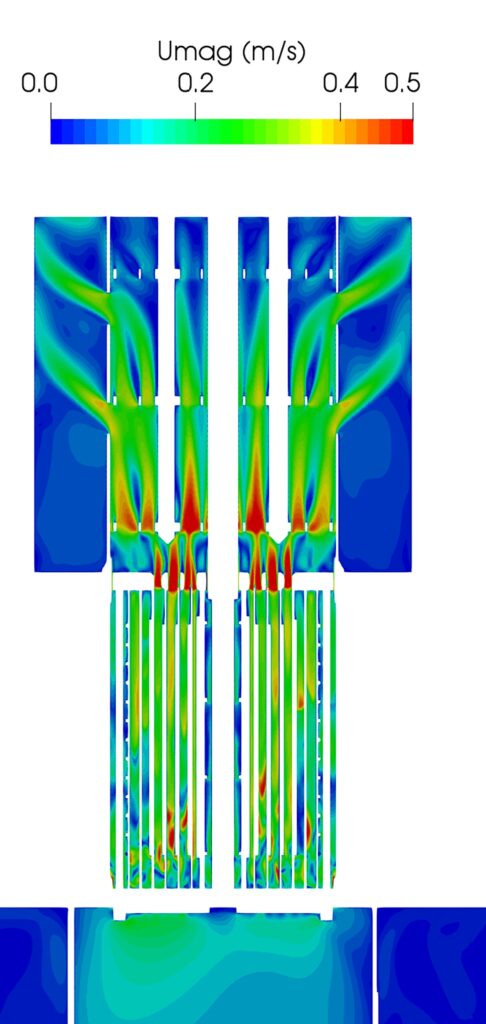
Velocity field in the core of E-SCAPE
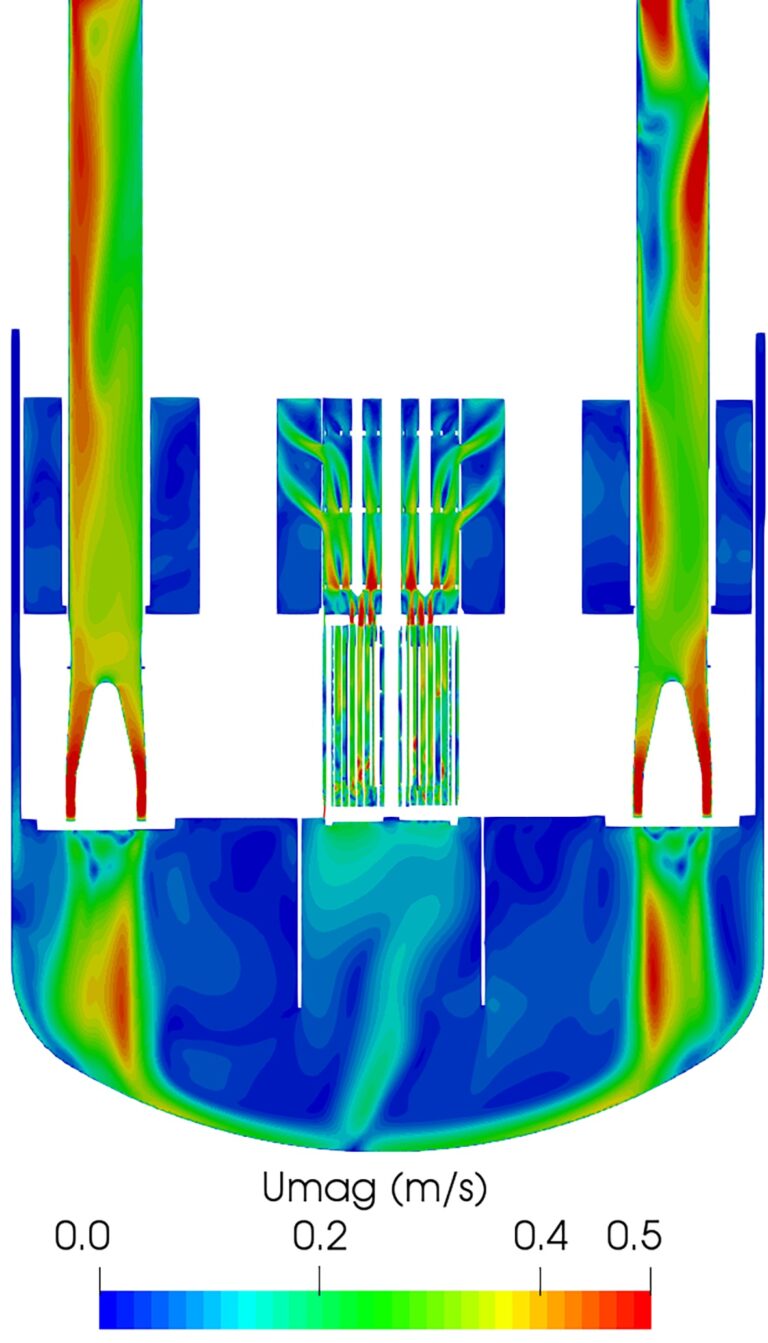
Velocity field in the mid-plane of E-SCAPE
An interesting aspect of this project was that it was all carried out using low-order codes.
“Usually in my field, direct numerical simulations would be done with highly specific codes,” says Koloszar. “What we have shown is that there is now a real need for high-performance computing beyond the world of academia and highly-specialised codes, and also that these low-order codes can actually scale very well on these huge problems.
“Working with Tier-0 resources has been an amazing experience. Usually with such huge geometries, you start the simulation and then come back to get the result one month later. Instead, we were able to run on hundreds of nodes consisting of thousands of processors and get our results back in a few days. Being in a situation where your brain and your practical capabilities are the bottleneck rather than the simulation time is an excellent challenge. As researchers, we always want to develop to become better and better, so when we are challenged like this we are happy!”
This article was also published in PRACE Digest 2021.
More information:
https://www.vki.ac.be
Resources awarded:
This project was awarded 30 000 000 core hours on Joliot-Curie Rome, hosted by GENCI at CEA, France
Contact
For all questions about PRACE communications, promotional and press materials, social media, and publications: communication@prace-ri.eu