

Professor Leonardo Giusti of the University of Milano – Bicocca has been using supercomputers to explore the Standard Model and, in particular, developing a new algorithmic invention to measure the specific properties of one of its fundamental particles – the muon. The work concentrates on the discrepancy between the theoretical prediction of the anomalous magnetic moment of muons and its experimental value, and the idea that there may be new physics at play which is causing this anomaly
The discovery of the Higgs boson at the Large Hadron Collider in 2012 represented the last missing piece of the Standard Model, the crowning achievement of modern particle physics. Today it explains the results of experiments conducted in laboratories on a huge variety of processes. However, evidence from astrophysics and theoretical arguments suggest that the Standard Model may in fact be an effective low energy description of a more fundamental theory.
Professor Leonardo Giusti of the University of Milano – Bicocca is a theoretical physicist who uses high performance computing to try to explore the Standard Model and look for hints of the physics that may lie beyond it. In particular, he has been working on algorithmic developments for
measuring specific properties of one of the fundamental particles of the Standard Model – the muon.
Muons, along with electrons and tauons, make up a category of particles known as leptons. “Muons are essentially very similar to electrons, with the same quantum number and fundamental properties, but are around 207 times heavier,” says Giusti. Just like electrons, muons have a property called the magnetic moment, which dictates how the muon interacts with magnetic fields. In 1928, predictions for values of this property for electrons were made by Paul Dirac by combining special relativity and quantum mechanics.

“Our algorithm entirely factorises the propagation of the quark”
Leonardo Giusti
However, it is now known that the magnetic moment of a particle such as a muon is also affected by the existence of other fundamental particles. This causes a deviation from Dirac’s prediction which is known as the anomalous magnetic moment. In the 1950s, this anomalous portion was first computed and also validated through experiments for electrons and muons. This in turn validated the theory of quantum electrodynamics and allowed for the Standard Model to be built based on what is known as quantum field theory.
The most precise measurements of the anomalous magnetic moment of the muon today have a precision of 0.35 parts per million, achieved by the E821 experiment at the Brookhaven National Laboratory and the E989 experiment at Fermilab. “The most recent number from Fermilab was released in April 2021, and it was similar enough to the figure released from Brookhaven for experimentalists to say with good certainty that it could be trusted,” says Giusti.
Interestingly, theoretical predictions of the anomalous magnetic moment based on other observables differ from these experiments by more than four standard deviations. This discrepancy has given rise to the idea among high energy physicists that there may be new physics at play, as yet not understood, which is causing the discrepancy between the theoretical prediction and the experimental value. So where does the theoretical uncertainty come from? To calculate the anomalous magnetic moment from theory, the contributions from all other particles have to be taken into account. As it turns out, it is the contribution from the strong interactive particles called quarks and gluons that dominate the uncertainty in the theoretical prediction.
Giusti has been leading a PRACE project in which he has been designing and testing a new algorithm for computing this particular contribution, known as hadronic vacuum polarisation, to the anomalous magnetic moment of the muon. The aim is to try and bring the precision of the measurement of this contribution in line with the expected experimental error that will be achieved in next few years by Fermilab.
“To meet this experimental error, we have to reach a precision of 0.2 per mille in our calculation,” says Giusti. “Using indirect computation based on other experimental results, it is possible now to achieve a precision of 0.6 per mille. With direct computation the error is much higher, but we aim to change this with our new algorithm.”
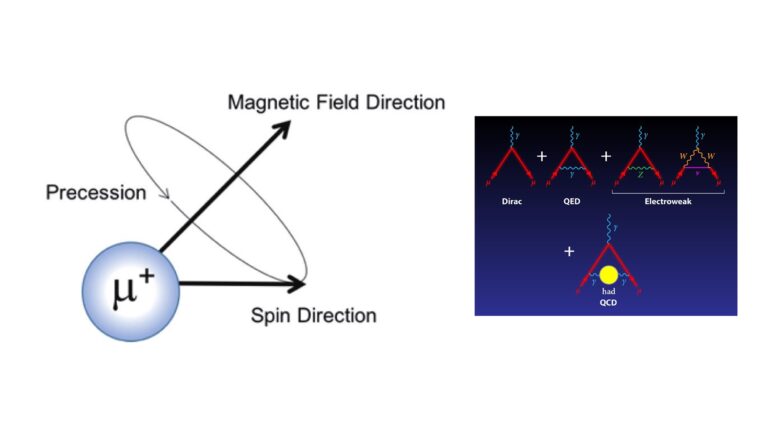

The precession of a muon around the magnetic field is shown, left, and, right, the Feynman diagrams which represent the various contributions to the magnetic moment the muon are depicted. The hadronic vacuum polarisation is shown as a yellow bubble in the last contribution (APS/Alan Stonebraker).
Direct computations of this particular contribution involve simulating a quark and anti-quark pair propagating through space and time, and calculating the so-called hadronic vacuum polarisation. This cannot be done on paper, as the theory of the strong interaction, known as quantum chromodynamics, cannot yet be solved analytically. Therefore, high-performance computing resources are used instead, using Monte Carlo simulations in which time and space are discretised into giant lattices consisting of millions of points mapped out on to thousands of processors in parallel. The novelty of Giusti’s algorithm is that it is able to subdivide the lattice into sub-blocks, so that computations of each region can be done independently. “Before, all of the computation would have had to be done together, meaning that to compute the propagation of the quark on one side, you would have to know what is on the other side. Our algorithm instead entirely factorises the propagation of the quark.”
This new algorithmic invention solves two problems. Before, to reduce the error of the measurement by a factor of 10 would have required an increase in computational power of 100. By factorising the computation completely, the increase in computational power needed is reduced to 10, which will be possible with upcoming pre-exascale and exascale computers. As well as this, the new algorithm will make parallelisation of the quark dynamic calculations much simpler.
The project finished in April 2021, and the results have been published in Physics Letters B and presented at ICHEP 2020 and at the Lattice 2021 conference at MIT. “The algorithmic development has now been completed thanks to the allocation from PRACE,” says Giusti. “Our next step now is to use this algorithm to carry out the actual computation of the hadronic vacuum polarisation contribution, which should take place in the next few years.”
This article was also published in PRACE Digest 2021.
More information:
https://en.unimib.it/leonardo-giusti
https://virgilio.mib.infn.it/~lgiusti/lgiusti.html
Resources awarded:
This project was awarded 40 000 000 core hours on JUWELS, hosted by GCS at FZJ, Germany.
Contact
For all questions about PRACE communications, promotional and press materials, social media, and publications: communication@prace-ri.eu