- This event has passed.
PRACE@ISC 2026
We had a great time at ISC 2026, meeting so many inspiring people in HPC!
Keep up to date with PRACE news and activities by subscribing to our newsletter!
HPC, AI, Quantum: Powering Innovation and Sustainability
ISC 2026 connects scientists, engineers, and technology leaders to explore the future of high performance computing. The conference will examine today’s breakthroughs in artificial intelligence, high performance computing and quantum technologies, as well as what lies ahead. Additionally, ISC 2026 is committed to sustainability by promoting energy-efficient and cost-effective computing, while empowering the next-generation workforce to continue the community’s legacy of innovation.
Find the PRACE company page in the ISC 2026 event app (SwapCard) by scanning this QR code:

Exhibition & Booth Activities
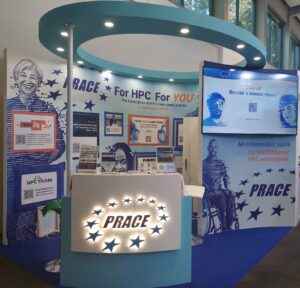
PRACE will be present again on the ISC 2026 exhibition floor!
Come visit us at booth A01, near the entrance to the exhibit hall.
A presentation of the HPCTRAIN Project will be given by Veronica Teodor at the EuroHPC booth (J30) on Tuesday 23 June at 17:00 (the other presentations at the EuroHPC booth can be found here) and at the GCS/FZJ booth (K02) on Thursday 25 June at 10:15.
Women in HPC

As an Affiliate of Women in HPC (WHPC) we support WHPC at ISC 2026.
(please contact WHPC directly for any queries)
Birds-of-a-Feather Session
Aligning HPC Strategies: Scientific and Innovation Case for HPC in Europe in light of the ETP4HPC SRA and other European HPC initiatives
Tuesday 23 June, 14:15-15:15, Hall G1 – 2nd floor
Go here for the ISC 2026 schedule
Several strategy papers for HPC and AI in Europe are published on a regular basis. PRACE is updating the Scientific and Innovation Case for HPC every 5 years. ETP4HPC, the European Technology Platform for HPC is issuing the Strategic Research Agenda (SRA) for HPC approximately every two years addressing the European HPC HW, SW and application technology development. Both reflect in particular the state of the European Advanced Computing ecosystem, which includes in-production HPC and AI infrastructures and emerging Quantum Computing (QC) resources. The EuroHPC JU publishes every year updates of its Multi-Annual Strategic Plan (MASP) which describes the state-of-the art in HPC, AI and QC HW, SW, applications and use cases, discusses R&D priorities for the next 3-4 years and recommends actions to be included in the EuroHPC JU work programmes. Last but certainly not least, specific projects like SPECTRUM and communities have authored position papers and research agendas which s bring forward requirements and propose strategies for HPC and AI in Europe. These strategy papers, case studies and research agendas provide valuable input for policy makers to design the future funding programmes and to justify the investments in HPC, AI and Quantum Computing. They all aim to support sound policy decisions for investments and projects in order to strengthen Europe to keep pace with the global race in HPC, AI, and QC. However, the accelerating convergence of HPC, AI, data infrastructures and emerging QC resources — together with the growing integration of large-scale European Research Infrastructures (such as CERN, SKAO and similar facilities) — makes systematic cross-analysis of these documents both timely and necessary. In this BoF we will have a closer look at the individual recommendations contained in the latest versions, and we will compare the key findings and messages of the Scientific and Innovation Case for HPC in Europe with the recommendations of the ETP4HPC SRA and the EuroHPC JU MASP. We will identify and discuss areas of strong alignment between demonstrated HPC impact and strategic research priorities. More important however, we will highlight gaps, mismatches, or underrepresented topics between the strategy documents, and discuss these with the audience. By doing this the proposed BoF will help to create a synopsis, include feedback from end users, operators of HPC/AI/QC resources, providers of HW and SW technology in the European HPC ecosystem, and foster a productive dialogue between these and policymakers and, and strategic planners.