

The evolving landscape of European supercomputing
While many at SC22 gathered to watch the TOP500 supercomputer session, the real connoisseurs were attending the smaller but no less important event that was the European HPC Ecosystem Summit.
In 2018, PRACE engaged in the coordination of several European HPC activities, including access to HPC systems, user support, training, policy, technology, operations and dissemination. These initiatives led to the development of the HPC in Europe Portal, a mechanism to structure and present European HPC services.
Since then, the European HPC strategy has undergone several big changes, with the entry of the EuroHPC Joint Undertaking (JU) and new coordination actors. The objective of this Birds of a Feather session was therefore to present the current status of the ecosystem, discuss further exploitation of the HPC portal, and include the user experience from the Castiel/EuroCC network of European Competence Centres.
The past, present and future of HPC in Europe
PRACE’S Operations Director Florian Berberich kicked off the session by giving an overview of how the European HPC ecosystem has been evolving in recent years. He described the four facets that needed to be maintained to ensure it runs smoothly: infrastructure for making computing available, hardware development, software development, and pan-European coordination. Of course, this last facet now widely rests on EuroHPC, which has brought in a huge amount of funding for new HPC ecosystems (including LUMI, the third most powerful system in the world), and is aiming to widen usage and skills related to HPC in academia and industry.
Two other important additions have been added to the European HPC ecosystem as part of EuroHPC. The CASTIEL project will coordinate and support the national competence centres that will be set up as part of EuroHPC, and EuroCC will act locally to map available national HPC competences and identify existing knowledge gaps, encouraging integration and collaboration between the competence centres to strengthen the European ecosystem and serve HPC users in Europe.
Berberich concluded by saying that investment in HPC in Europe was of paramount importance to keep pace in the global race. Europe must be inclusive and excellent, taking advantage of the diversity of contributions that the EU has to offer. But most of all, it needs to continue to value the people in HPC – they, more than any other factor, are the drivers of a good ecosystem.
The HPC in Europe Portal
Oriol Pineda of the Barcelona Supercomputing Centre spoke next about the latest developments of the HPC in Europe Portal. The objective of the HPC in Europe Portal is to collect and group European HPC services through a bottom-up approach and the creation of a centralised database that can be accessed by all stakeholders. HPC access, training and events, applications, technology and documentation will all be available through the portal. Target groups for the portal include researchers, industry, communities, students and the general public.
The HPC in Europe Portal aims to be user-oriented, easily adaptable to future changes, convenient to administrators, allow automated imports, have neutral European branding, and provide acknowledgment to contributors. The overall objective is to develop and make available a framework for all stakeholders to use and benefit from, and then promote and facilitate the use of this framework. It will not just be a simple collection of external links, instead providing lots of useful contextual information around everything held in the framework.
EuroCC and CASTIEL
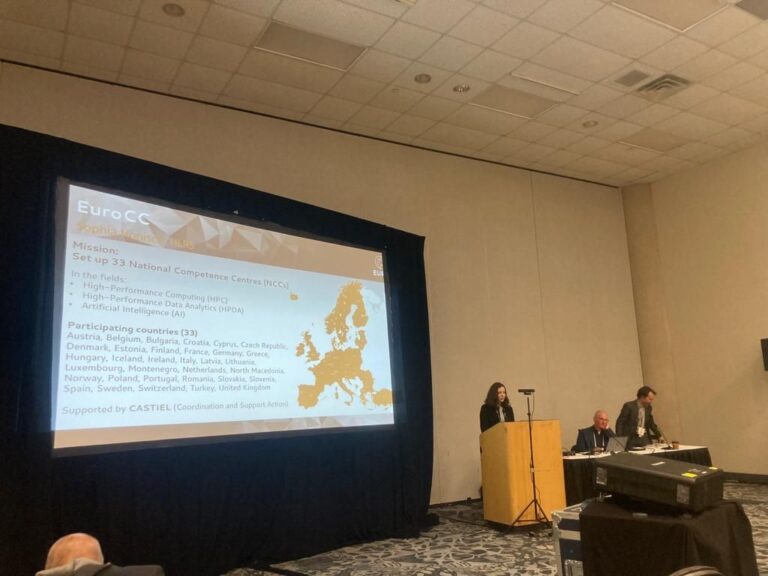
Sophia Honisch was at the event representing the EuroCC and CASTIEL projects. EuroCC was set up to establish 33 national competency centres (NCCs) throughout Europe in the fields of HPC, high performance data analytics, and AI. The goal is to provide a portfolio tailored to the needs of industry, academia and public administration, and to catalogue and increase national agency competencies around these areas.
The long-term ambition is to establish the NCCs as single points of contact towards the world of HPC in each country, and also for the EU overall. At the end of the project, all NCCs will have developed a broad service portfolio and will show improvement of their overall structure and handling of users, which is continuously being tracked by the project management team of EuroCC.
CASTIEL is the coordination and support action of EuroCC, which aims to support and connect the NCCs. It will enable them to get closer together in terms of capabilities and expertise and create a European excellent baseline by closing existing gaps in knowledge. The next phase of the project, CASTIEL 2, will establish an information sharing system called C2ISS to collect all kinds of information on training, success stories, available codes, and documentation of new developments.
