
Perovskites are versatile materials that have a wide variety of characteristics and can be used as building blocks to create more complex structures that have several interesting properties. In their PRACE project, Dr João Pedro Esteves de Araújo and his team at the University of Porto have been investigating these materials and looking in particular at negative thermal expansion, which has a number of potential applications including high-precision optical and microelectronic devices
Dr João Pedro Esteves de Araújo of the University of Porto leads a team of condensed matter physics researchers in the study of complex materials with useful properties, combining experimental work with computational studies to gain a deeper understanding of how these materials function. “Our approach involves using macroscopic techniques for fully characterising new materials,” he says. “Then, if we find sufficiently interesting properties, we use local probe techniques to provide more details.”
The group’s work has covered materials with a broad variety of physical properties, from high-temperature superconductors to colossal magnetoresistance oxides. More recently, they have been looking at room temperature magnetoelectric compounds, in which the magnetic and electric properties of the material are coupled. It is thought that materials known as perovskites may represent good candidates for creating such compounds.
Perovskites are materials with a specific crystal structure and the chemical formula ABX3, where ‘A’ and ‘B’ represent cations and X is an anion that bonds to both. Many different elements can be combined to form perovskite structures and, using this compositional flexibility, scientists can design perovskite crystals to have a wide variety of physical, optical, and electrical characteristics.

“Using simulations, we can play around with the rotation and tilt of these octahedra to enhance the ferroelectric and magnetic properties of the materials. We can predict the properties of these proposed materials extremely accurately, providing us with insights that macroscopic techniques cannot.”
João Pedro Esteves de Araújo
Although the structures of perovskites are simple, they can be used as building blocks to create more complex structures that have several interesting properties. These properties can be tweaked and refined by introducing instabilities in areas known as oxygen octahedra. Dr Armandina Lopes, a senior researcher and colleague of Araújo at the University of Porto, explains how a recent PRACE project has helped them investigate these materials. “Using simulations, we can play around with the rotation and tilt of these octahedra to enhance the ferroelectric and magnetic properties of the materials. We can predict the properties of these proposed materials extremely accurately, providing us with insights that macroscopic techniques cannot.”
Araújo’s team has been carrying out this computational work as part of a larger project in which others have been synthesising the materials and characterising them using local probe techniques at CERN. “We realised that we needed much more computational power than was available in Portugal to match up with the experimental work being done,” he says. “That is why we applied for this PRACE project, and it has really helped to bring our team together in terms of getting theoreticians, computer-oriented physicists and experimentalists to work towards a common goal.”

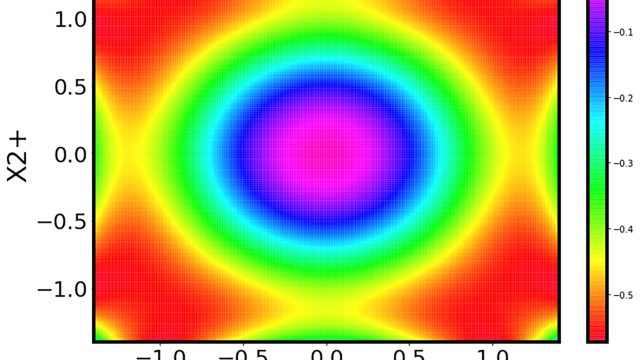
Energy barrier according to polarization switching via the X2+ or X3- irreducible representations of the I4/mmm space group. The center (large energy area) represents the structure with no rotation and no tilt applied, i.e., the I4/mmm space group. The red corners (low energy area) represent the four possible structural domains of the phase transition to the A21am space group.
Following a previous publication that described a new group of multiferroic materials developed in this way called hybrid improper ferroelectrics, Araújo and his team have been able to study them further, particularly looking at a property known as negative thermal expansion. Typically, materials increase in volume when their temperature increases, but these materials do the exact opposite. As well as this being interesting in its own right, there are a number of potential applications for materials with this property, for example high-precision optical and microelectronic devices. This PRACE project has allowed the team to understand the mechanism via which it occurs in natural layered perovskites.
One of the properties that the team were able to measure at CERN in the hybrid improper ferroelectric materials is what is known as the electrical field gradient. They have now had a paper published which made the cover of Journal of Materials Chemistry C that looks at the relation between electrical field gradient and the structures of these materials.
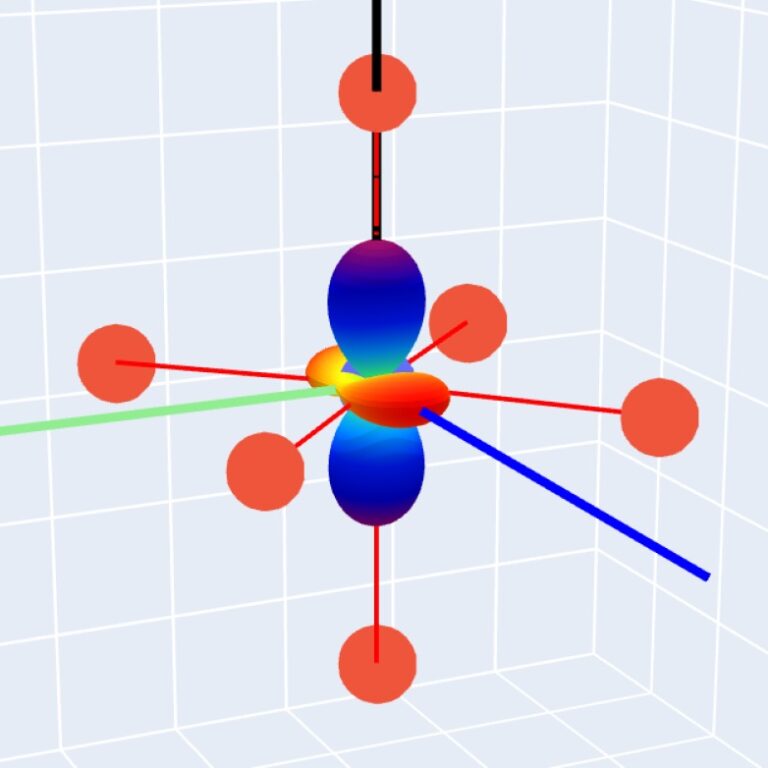
Electric field gradient surface of Mn at the high-temperature centrosymmetric structure with space group I4/mmm. Green, blue, and black lines represent Vxx, Vyy and Vzz directions, respectively. Red spheres represent oxygen atoms.
As many scientists will confess, research often creates more questions than it answers. While using what is known as local probe techniques to study their materials at the ISOLDE facility at CERN, the team began questioning whether the probe itself could become part of the material, as Araújo explains: “We were using an isotope called cadmium-111m as our measurement probe, when we started imagining ways in which this isotope could be used as an element in new materials. We are now working on simulations to explore the potential of cadmium.”
The group has now won a further allocation of computing time from PRACE in order to continue their work. While the previous work was done on the Marconi100 machine, Araújo was advised to apply to a different machine – Joliot-Curie – for this next stage. “When you submit a proposal with PRACE, it undergoes a rigorous process of technical and scientific review,” he says. “Our referees saw that we were looking to use genetic algorithms to generate potential new structures that we could then test, and pointed us towards tools that could do this in an integrated way. However, these tools were much better suited to the Joliot-Curie architecture, so we were glad to receive this advice in the process of applying.”
This article was also published in PRACE Digest 2021.
More information:
http://www.ifimup.up.pt
Resources awarded:
These projects were awarded a total of 25 700 000 core hours on Marconi100, hosted by CINECA, Italy
Contact
For all questions about PRACE communications, promotional and press materials, social media, and publications: communication@prace-ri.eu