
Studying excitons and how they behave in certain materials is shedding light on the design of optimal materials that can be used in applications like energy conversion and energy storage. Dr Sivan Refaely-Abramson describes her work on this at the Weizmann Institute of Science in Israel as being at the intersection between physics, chemistry and materials science
When light shines on a material, something very exciting happens. Photons of light excite negatively charged electrons in the material to higher energy levels, leaving behind empty positive charges in the lower levels called holes. These negative electrons and positive holes can then be attracted to each other, forming what are known as excitons.
In most materials, these excitons quickly collapse when the elevated electrons simply return to their original state and scatter the light energy. However, in some special materials, the excitons can remain stable and efficiently transfer the energy. Such materials are known as excitonic materials and are ideal for solar energy conversion and energy storage.
Investigating these kinds of materials is at the heart of Dr Sivan Refaely-Abramson’s research, which lies at the intersection between physics, chemistry and materials science. After a PhD in which she developed methods for predicting properties of materials that could be used for organic photovoltaics, she then completed a postdoc at Berkeley where she learned advanced computational methods for understanding what happens when light interacts with such materials.

“We study how excited states in materials evolve over time, how they decay, and whether we can make them last longer”
Sivan Refaely-Abramson
Refaely-Abramson now leads her own research group at the Weizmann Institute of Science in Israel, and the study of excitons and their properties makes up a significant part of their work. “We study how excited states in materials evolve over time, how they decay, and whether we can make them last longer,” she says. “The properties of excitons are entirely dependent on the structure of the material they appear in, and if we are able to understand how and why these excitations can survive for a long time, it opens up the possibility of designing optimal materials for use in applications such as energy storage.”
In order to fine tune the structure of materials to improve the properties of excited states, predictive methods are needed. But to understand excited states at the predictive level, one must enter the realm of many-body quantum theory, an area of physics which provides a framework for understanding the collective behaviour of large numbers of interacting particles. While the underlying physical laws that govern the motion of individual particles are relatively simple, the study of larger numbers of particles is complicated by specific quantum phenomena that only manifest in such large systems.
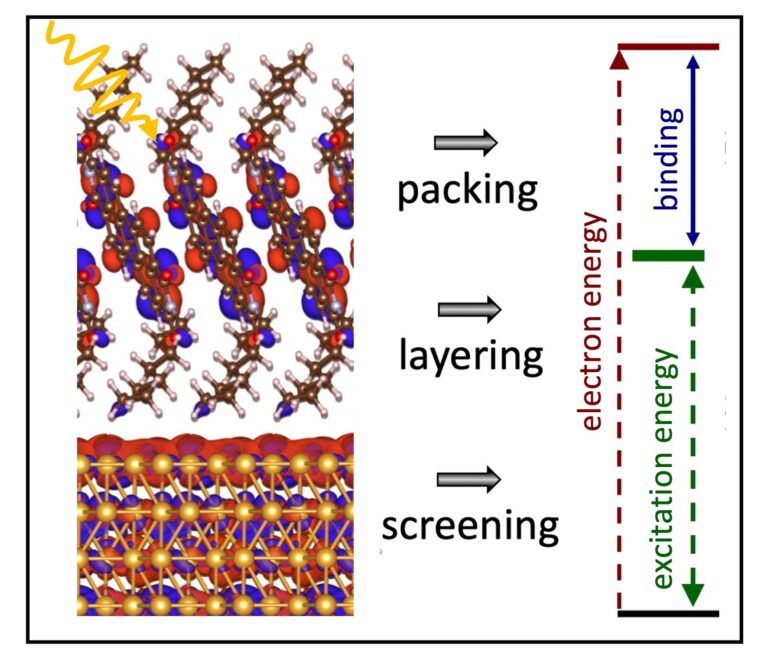
An illustration of light excitation in an organic molecular crystal adsorbed on gold surface. The crystal molecular packing, the number of layers in it, and the environmental screening influence its electronic and excitation properties, as studied using advanced computational methods [Shunak et al., Front. Chem. 2021].
While the most common way of dealing with these phenomena is to calculate an average estimation of their effects, Refaely-Abramson’s group endeavours to provide a much more accurate depiction using what is known as many-body perturbation theory. This theory is an approximation of the many-body Schrödinger equation – an equation that provides the solution to understanding electronic properties in quantum problems, but which is impossible to solve in its complete form for systems of any significant size. So, how does this relate to excited states in materials? Many-body perturbation theory allows the group to gain a deeper understanding of excited states in materials by finding out how one particle scattering or moving effects the other particles in the system. These “response functions” are calculated using a code called BerkeleyGW, which when run on high-performance computers enables the researchers to predict the properties of energetically excited states in materials.
A recent PRACE project led by Refaely-Abramson aimed to study energetically excited states in heterogenous photocatalysts. The examined systems contain both organic and inorganic materials, and excited states occur at the interface of these materials which can then be used for energy conversion and storage. At present, most known photocatalysts are very inefficient, and although the reasons for this are understood, the right materials to improve this efficiency have not yet been discovered. Refaely-Abramson’s group is now part of a global effort to try and find them. “Our aim is to create predictive structural design principles that will help in the discovery of more efficient photocatalysts.”
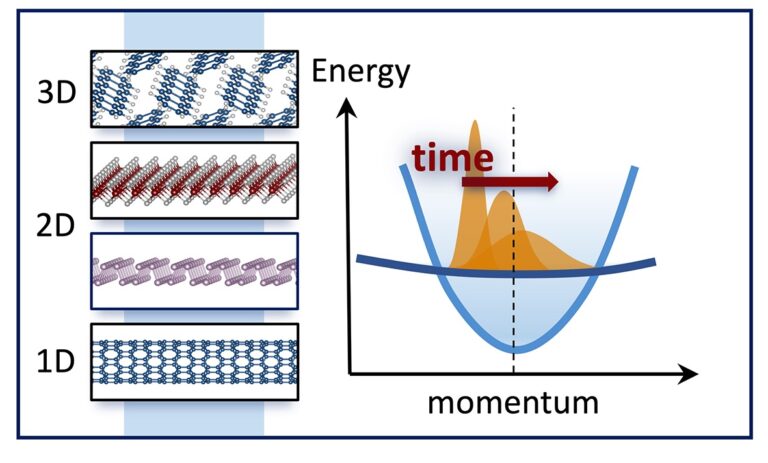
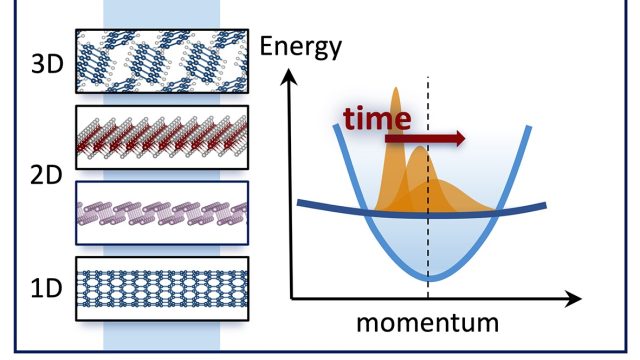
The time propagation of energetically-excited quantum states depend on crystal momentum properties. A new theoretical approach demonstrates that crystal dimensionality dominates this propagation, allowing direct detection of materials’ structure and symmetry through experimental measurement [Qiu et al., Nano Lett. 2021].
The project has resulted in three publications. The first of these showed how the dynamics and lifetimes of excitons are related to crystal dimensionality in energy materials, and used these findings to present a way of predicting their structure and symmetry through experimental measurement. The second paper explored excited-state processes at organic-inorganic interfaces consisting of molecular crystals, in which molecules are packed together in a very specific orientation on a surface of gold. “We wanted to understand how the packing and symmetry associated with the dimensionality of the crystals affected the dynamical properties and nature of the excited states,” says Refaely-Abramson. Finally, the third publication provided a detailed description of the electronic structures of excited states in a specific photovoltaic material.
The allocation from PRACE has been crucial for the completion of the group’s work. “Israel does not as yet have a Tier-0 supercomputer, but luckily we have had the opportunity to apply for access to PRACE resources,” says Refaely-Abramson. “A big part of what makes the experience so good is the staff who are there to support you. In previous generations, I think it was thought that if you did computational work, you should take care of everything yourself, but this is actually not the best way to optimise such research. It is much better to work alongside technical experts, and I was very happy to find that PRACE had many such experts to help us along the way.”
This article was also published in PRACE Digest 2021.
More information:
http://www.weizmann.ac.il/materials/Sivan/home
Resources awarded:
This project was awarded 30 000 000 core hours on MareNostrum 4 hosted by BSC, Spain
Contact
For all questions about PRACE communications, promotional and press materials, social media, and publications: communication@prace-ri.eu