

Theoretical astrophysicist Professor Luciano Rezzolla is the latest winner of the PRACE HPC Excellence Award. Setting out with the simple premise of “what happens if you take a bucket of plasma and throw it into a black hole”, his work on the first-ever image of a black hole has led to remarkable discoveries about these astronomical bodies and their gravitational forces.

When the first-ever image of a black hole was released in 2019 by the Event Horizon Telescope (EHT) collaboration, it marked an historic moment for science. But capturing the image was only the first step. Understanding what it meant – interpreting an unprecedented view of the universe – posed an entirely new challenge. Professor Luciano Rezzolla, Chair of Theoretical Astrophysics at the Institute for Theoretical Physics at the University of Frankfurt AM, Germany, took on this challenge with his collaborators, crafting a novel approach that has now earned him the PRACE HPC Excellence Award for 2024.
As a theoretical astrophysicist Rezzolla focuses his research on theoretical modelling to understand astronomical compact objects and how they work, so when the first image of a black hole emerged, he set about to answer the fundamental question of ‘why’ the image that had been captured looked the way it did.
“Essentially, my work involves modelling what happens near black holes and neutron stars, studying events like the collision of two neutron stars or black holes and the gravitational waves they emit,” he explains. “To do this, I use Einstein’s theory of general relativity, which consists of highly complex equations – Einstein’s field equations. These equations do not have analytical solutions except in highly simplified cases, such as scenarios with perfect spherical symmetry, so as a result, solving them requires numerical computation using high-performance computing (HPC) and specially designed numerical codes.
“This was our major challenge,” he continues. “The equations we solve are not just difficult but extremely nonlinear, which means that without supercomputers and these sophisticated numerical codes, we wouldn’t be able to make progress in understanding what we saw in the black hole images.”
Rezzolla’s involvement in the EHT project began in 2014 when he and two colleagues (H. Falcke and M. Kramer) secured an ERC Synergy Grant to take this first-ever image of a black hole. The project combined cutting-edge observational techniques – linking eight of the world’s most advanced radio telescopes to create a virtual Earth-sized dish used to capture the image – with Rezzolla’s groundbreaking theoretical analysis to interpret that image.
The first element of this project was primarily technological – assembling the telescopes and capturing the image. Once the image had been captured, Rezzolla and his team set about the task of interpreting the vast amount of data to explain why the image – often described as resembling a “half-eaten doughnut” – appeared as it did and to do this, they returned to solving the complex, nonlinear equations that describe how plasma behaves near black holes.
To find this out, Rezzolla and his team had to solve equations governing both the plasma’s motion and how it interacts with light. Since light behaves “strangely” near a black hole –curving due to extreme gravity – they also had to address a radiative transfer problem, which studies how light is produced, propagates, and reaches us on earth.
“Put simply,” he says, “we needed to model what happens when plasma falls into a black hole and how it interacts with light.”
This required solving equations governing fluid dynamics, magnetohydrodynamics (MHD), and radiative transfer – a formidable computational task. Each simulation could take weeks, and the team needed to run hundreds of them. The full analysis took about a year.
Computational breakthrough
The process involved in these simulations consisted of three key steps using HPC. First was to run simulations of plasma interacting with black holes and this required weeks of HPC time per simulation. This was followed by the generation of synthetic images, each taking about 10 minutes to produce and leading to the production of millions of images. These synthetic images were then compared with actual observational data, a process that required processing terabytes of data.
Rezzolla emphasises that while his team did not develop entirely new computational methods to do this work, they pioneered an entirely new workflow. “We had to design the entire pipeline from scratch because no one had taken a picture of a black hole before. We also had to accept setbacks. Since we didn’t know the exact physical conditions around the black hole, some simulations turned out to be incorrect, requiring us to adjust our models and refine our approach.”
Much of the team’s innovation lay in determining how to interpret the data and the results proved to be groundbreaking, providing the first direct evidence that supermassive black holes exist and that the structures observed in these first images are shaped by plasma and magnetic fields. “This was more than confirming a hypothesis,” explains Rezzolla. “This was the first direct evidence that supermassive black holes exist in the centre of galaxies and can be revealed by the light of the infalling matter. While this concept is widely taught, even to schoolchildren, science requires rigorous validation of hypotheses and we were able to test theoretical predictions against real data to provide that validation.”
Insights into black hole accretion and galactic evolution
Beyond confirming the existence of black holes, Rezzolla’s research has deepened our understanding of accretion – the process by which black holes consume matter. Black holes sit at the centres of galaxies, surrounded by chaotic environments where stars lose material, collide, and create interstellar gas. This gas eventually drifts into the black hole’s gravitational pull.
“Our simulations helped refine existing theories on how black holes grow and how their powerful magnetic fields influence the surrounding environment,” he says. “We also extracted information about black hole properties – their mass, spin, inclination – by matching synthetic images with observations.”
This research has far-reaching implications for astrophysics. By confirming that supermassive black holes exist in at least two galaxies that were studied, the idea that similar objects exist in billions of galaxies across the universe is now strongly supported. Rezzolla’s work represents a major step forward in the understanding of black holes and lays the foundation for future observations and theoretical advancements in astrophysics.
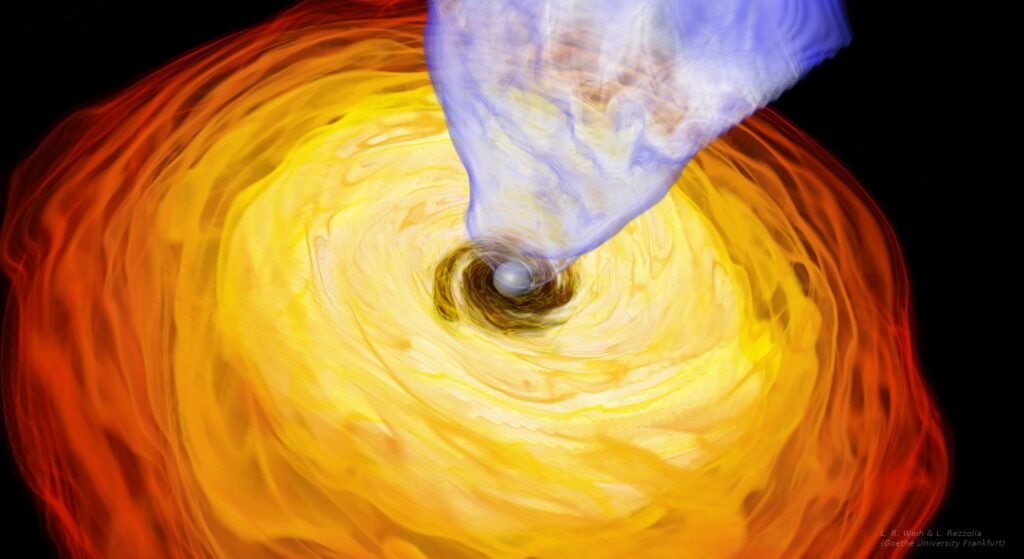
The role of HPC in the future of astrophysics
Rezzolla credits HPC as the backbone of these discoveries. “Science is moving toward a future where almost all research will involve numerical simulations,” he says. “Whether modelling black holes or viruses, we need sophisticated computational tools.”
As a longtime user of PRACE’s computing resources, Rezzolla highlights the importance of PRACE in supporting fundamental research. “PRACE provides access to world-class HPC infrastructure, but it also serves as a voice for researchers. It ensures that scientific computing resources are available for projects that push the boundaries of knowledge and not just for commercial exploitation.
“The ability to explore fundamental questions about the universe should not be limited to projects with immediate financial returns. PRACE plays a vital role in maintaining this balance, ensuring that scientific curiosity continues to drive discovery.”
Rezzolla also sees how the growing reliance on HPC should shape the way young researchers enter the field. “We need to change how we educate future scientists,” he argues. “It’s no longer enough to know physics and be proficient with the mathematics behind physical laws – we must train students in numerical methods, algorithm development, and the use of HPC infrastructure to explore physical phenomena in regimes inaccessible analytically. This shift is already happening, and it’s crucial for the next generation.”
But he warns of an “over-reliance” on computational outcomes to experiments. “I also stress the importance of critical thinking,” he says. “Never blindly trust computational results. A simulation might produce an answer, but it needs rigorous validation. Always cross-check findings through multiple tests and, when possible, derive simple mathematical models to interpret the results. Science isn’t just about obtaining answers – it’s about understanding them.”
Looking ahead
Rezzolla is humble when speaking of his achievements and of receiving the PRACE HPC Excellence Award, but he acknowledges it as being a significant honour for him and, importantly, his whole team as he remains focused on the challenges ahead. “I’m deeply grateful for this recognition, but the journey is far from over,” he says.
One of his biggest scientific dreams when considering his future work is to generate a better understanding of neutron stars. These are some of the densest objects in the universe, with a radius of about 12 kilometres yet containing more mass than our entire solar system. Our understanding of neutron stars is just starting to evolve and Rezzolla is hoping HPC will help us unlock more of their secrets. “My motivation to reveal these secrets comes from the sheer fascination I have with these objects,” he explains.
“They embody some of the most advanced concepts in physics. In comparison, black holes are almost simple compared to neutron stars’ incredible complexity. They bring together all aspects of extreme physics – enormous densities, extreme temperatures, and intense magnetic fields.”
The stars intrigue Rezzolla even more when they collide when they produce some of the most enigmatic phenomena in astronomy, including gamma-ray bursts – intense flashes of gamma rays.
“We now understand that gamma-ray bursts occur when two neutron stars collide,” he enthuses. “But many details about the process remain unclear and questions remain: How do these stars merge in just the right way to produce a gamma-ray burst? What are the exact steps in this sequence?
“My dream is to shed light on this complex process. Using HPC and the most sophisticated numerical codes available, I hope to uncover new insights into how these extraordinary events unfold.”
With the recognition that the PRACE award gives him, Rezzolla is both excited and reflective of this future work. He sees it as a testament to the power of collaboration and computational science. “The future of physics and astrophysics is bright and it’s being driven by observation, theory, and, increasingly, by the power of HPC – and that is exciting,” he concludes.