
Inspired by micro-scale surface patterns found on bird feathers and shark skin, a research team from the STFC Daresbury Laboratory and the University of Manchester led by Dr Jian Fang, has been exploring the use of structures known as convergent-divergent riblets for controlling aerodynamic flow, which could help to improve efficiency and reduce energy use in several engineering applications.
When air passes over a wing, the strong pressure gradient can cause the flow to become messy and separate from the surface. By attaching fin-like structures called vortex generators close to the leading edge of the wing, it is possible to help the flow resist this surface separation and remain well-attached to the wing.
Although widely used today in various aerodynamic applications, one issue with vortex generators is their relatively large size, which can disturb the entire flow field if not used properly. To get around this limitation, researchers have been turning to nature for help, as Jian Fang of the STFC Daresbury Laboratory explains: “Sharks and birds are both well adapted to moving efficiently through fluid, be it water or air. If you examine shark skin or bird feathers under a microscope, they both share a common feature: small directional grooves invisible to the naked eye that are used to control the flow of fluid over the surface.”
Inspired by these bio-designed surfaces, Fang and his colleagues have set about exploring the possibility of using similar patterns in engineering. Naming their own version of these structures convergent-divergent riblets (CDRs), they have been using resources awarded by PRACE to confirm how CDRs are able to produce vortices, and to carry out a parametric study to explore the effects of various characteristics of the structures.
The project used a high-order finite difference flow solver developed by Fang called the ASTR code, which is a powerful tool for exploring the details of a given flow. In this study, the researchers carried out direct numerical simulations of a channel flow with CDRs implemented on the top and bottom walls, and fully resolved the turbulence down to the smallest scales to acquire every detail of the flow fields and see which parameters had the biggest effect on controlling the flow.

“As we increased the spaces between the riblets, the vortices became stronger, and through our simulations we were able to find the point at which the spacing produced the largest effect.”
Jian Fang
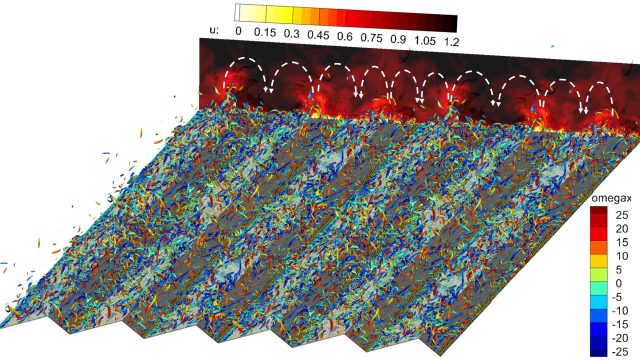
The project began by looking at the influence of the spacing between riblets. “In the flow field we could see that CDRs enhance momentum exchange and provide resistance to flow separation by generating what we call large-scale streamwise vortices,” says Fang. “As we increased the spaces between the riblets, the vortices became stronger, and through our simulations we were able to find the point at which the spacing produced the largest effect.”
Following this, the effects of the riblets on turbulence were explored. The CDRs, as expected, increased the levels of turbulence due to the enhanced momentum exchange that they produce. This stronger turbulence increased the levels of drag due to the increased friction against the surfaces of the channel. “What we found here is there is a trade-off between reducing flow separation at the cost of increased drag,” explains Fang. “However, we believe it might be possible to achieve reductions in both, which will be the subject of further studies.”
The next part of the study looked at the effects of the width of the converging and diverging strips. Narrower strips produced smaller vortices, while wider strips produced larger vortices. The ability to tune the size of the vortices by changing this parameter is an excellent characteristic of CDRs, as it provides the potential for engineers to refine the CDRs for specific applications, which is not possible with standard vortex generators.
Finally, the researchers studied the influence of the configuration of the riblets on performance. “In the standard configuration, we placed riblets all the way across the surface. Then, we trialled several different patterns, for instance gradually reducing the height of riblets towards the convergence lines,” says Fang. “We saw that the configuration of the secondary vortices was correlated to the configurations of these riblets.”

Turbulent coherent structures visualised using iso-surfaces of swirling strength and coloured with instantaneous streamwise vorticity, ω_x. The instantaneous streamwise velocity on a y-z slice is also presented to show the transport effect of the secondary vortices. (The computational domain is duplicated in periodic conditions for a better visualisation)
All of the simulations have now been completed, and Fang’s team is still analysing the wealth of data they have produced. What has been shown for certain is that the CDRs are able to generate large-scale vortices that can reach the entire height of the channel, and that the scale and strength of these vortices can be tuned by adjusting different parameters. In an ongoing study, the team are examining the effects of CDRs in Mach 2.9 supersonic flows, in which shockwaves can induce flow separation, and preliminary simulations have shown some promising results.
The resources provided by PRACE to Fang’s team have been fundamental to the research, as his colleague Charles Moulinec explains. “Before beginning this project, we were granted resources from PRACE to test out the code’s performance at scale on up to 100 000 cores. The results of this helped to shape the proposal for the project, as it allowed us to know with confidence that the code could run in an optimal way at this scale.”
Fang himself is also full of praise for what these computing resources and PRACE’s support has helped them achieve: “Without PRACE, this work could not be done. Here in the UK we have access to some Tier-1 and Tier-2 machines, but the high complexity of the meshes we used and the mathematical transformations we used to build them meant that Tier-0 resources were a must.
“Much of this work was done during lockdowns in the UK caused by the COVID-19 pandemic, and even then we were able to easily access the computing resources from our homes. PRACE also provided us with excellent opportunities for training in which we were able to optimise and tune the ASTR code. From there, we were inspired to reengineer the code to improve the IO performance, and this new version of the code will soon be released.”
This article was also published in PRACE Digest 2021.
More information:
https://scholar.google.com/citations?user=CcZ2Oz0AAAAJ&hl=EN
Resources awarded:
This project was awarded 60 000 000 core hours on Hawk hosted by GCS at HLRS, Germany
Contact
For all questions about PRACE communications, promotional and press materials, social media, and publications: communication@prace-ri.eu