

European supercomputers shone brightly at SC22 in Dallas this year, picking up several accolades at the prestigious annual TOP500 awards ceremony. Two European machines cemented impressive positions in the top five most powerful computers in the world, with Finland’s Lumi retaining its spot at number three and Italy’s Leonardo system the only new machine to break into the top 10, coming in at number four.
The Lumi HPE Cray EX system, operated by CSC at its data centre in Kajaani in Finland, first broke into the top 10 in 2021 when it burst on the scene in third spot. It had to undergo a major upgrade in 2022 to maintain its position in third place, however, with improvements doubling its size and allowing it to achieve an HPL score of 0.309 Eflop/s with 2 220 288 cores.

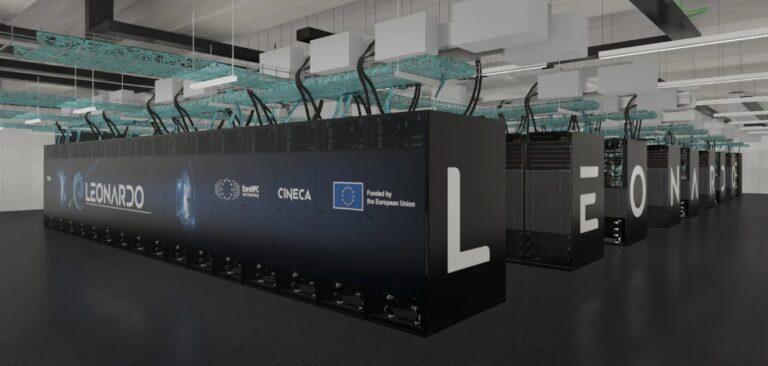
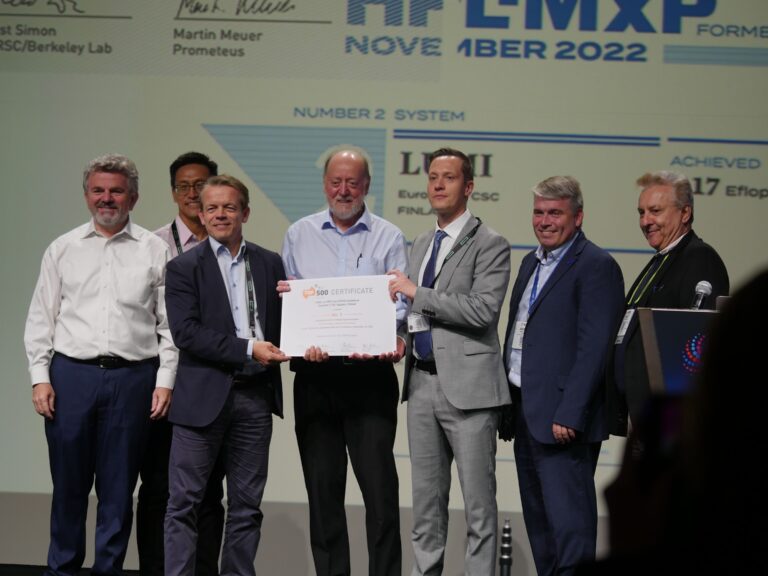
Both Lumi and Leonardo are systems funded by the EuroHPC Joint Undertaking (JU), which is now pooling EU resources to develop range-topping exascale supercomputers for processing big data in Europe. Key members of EuroHPC joined the teams from Finland and Italy in Dallas to receive the awards at the gala event.
Topping the table, with an HPL score of 1.102 Eflop/s was the Frontier machine from the Oak Ridge National Laboratory (ORNL) in the USA. The impressive machine was not able to improve on its 2021 score, but was still able to triple the HPL score of its nearest rival in second place, the Fugaku system at the Riken Centre for Computational Science (R-CCS) in Kobe, Japan which has an HPL score of 0.442 Eflop/s.
Frontier is the clear front runner in the race to exascale and the story of how it is making such great strides was the subject of the event’s keynote by Scott Atchley. He explained how the supercomputer achieved its chart-topping 1.1 Linpack exaflop run, a timely six months before SC22. Scott, a system architecture lead at ORNL, gave the packed hall what was at times an emotional blow-by-blow account of the painstaking process of getting more than 9 000 nodes to work as a single entity and how the 100-plus team worked night and day to reach the exascale goal.
Frontier is on track to enter full production in January 2023. In the run-up to this milestone, it has improved on its performance goals on two Exascale Computing Project (ECP) applications, with WarpX achieving a 110x speedup and Exasky achieving a 271x speedup over the Titan supercomputer.
ORNL also had success with Summit, its IBM-built system, which was listed at number five in the top 500 with a performance of 1.48.8 Pflop/s on the HPL benchmark.
Meanwhile, second place was taken by the Japanese Fugaku machine installed at the RIKEN Centre for Computational Science (R-CCS) in Kobe, Japan. It has 7 630 848 cores which enables it to achieve an HPL benchmark score of 442 Pflop/s.
Another major success for European supercomputing at SC22 came when the French Adastra machine from GENCI-CINES came in at the number three spot on the GREEN500 list as well as entering the main TOP500 at number 11. The Adastra system achieved an energy efficiency rating of 58.02 GFlops/Watts on top of an impressive HPL score of 46.1 Pflop/s.
The Swedish Dardel GPU run by KTH, the Royal Institute of Technology in Sweden, also impressed in the GREEN500, taking fifth position by achieving 56.491 Gflops/Watts, while Lumi backed up its showing in the TOP500 by coming in in seventh place in the GREEN500.
France, meanwhile, continued its success in the GREEN500 awards, with its ATOS THX.A.B machine picking up eight place and its Champollion-Apollo machine coming in at number 10.