
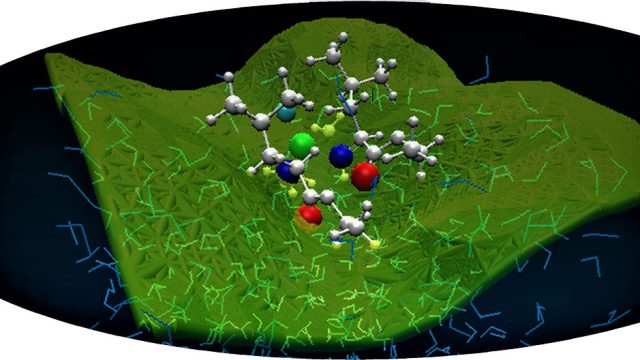
It is not known exactly how life on Earth first arose, but it is likely that it all began with the formation of a peptide. Professor Marie-Pierre Gaigeot of the Université d’Évry Val-d’Essonne has been investigating how this first step towards a biotic planet may have occurred at the interface between water and air.
Peptides are one of the fundamental building blocks of life. Finding out how they might have first formed from the primitive precursors of amino acids could provide a huge clue to how life first formed on Earth. There have been many hypotheses about how the so-called peptide bond condensation reaction may have first occurred in the prebiotic soup that existed billions of years ago.
Recent experiments by Professor Veronica Vaida of the University of Boulder in the USA showed that it is possible for this reaction to happen at interfaces between air and water, which would have been common in prebiotic times when the Earth was dominated by oceans.
Marie-Pierre Gaigeot of the Université d’Évry Val-d’Essonne is a researcher who specialises in investigating the structure and dynamics of water at interfaces, and how this structure impacts chemical reactivity.
One of her recent papers showed the existence of a special two-dimensional network of hydrogen bonds that exists at interfaces between air and water, and she is now looking at whether this network might provide the right conditions for peptide bond condensation to happen.
“Our investigations of this topic use density functional theory molecular dynamics simulations (DFT-MD). These are extremely computationally expensive, but it is necessary for us to model all of the electrons involved in this way as they play a fundamental role in whether a chemical reaction will occur or not in specific conditions.”
Marie-Pierre Gaigeot

The chemical reaction in question would be extremely unlikely to occur in a simulation without it being “forced” in some way. The researchers therefore bias their simulations so that they can not only observe the reaction happening, but also measure how much energy it costs to make it happen and decide whether this amount of energy would likely have been available in prebiotic conditions.
“To create the bias which leads you along the path of the chemical reaction, we had to decide coordinates of the reaction that made sense,” explains Gaigeot. “We did this by carefully examining literature about peptide bond condensation reactions, as well as using basic common sense from a chemistry perspective. Although this does introduce a level of guesswork on our behalf, there is no other way of observing this reaction in a simulation.”
Gaigeot and her colleagues carried out DFT-MD simulations of the reaction in a number of different situations. One of the main parts of their hypothesis was that the 2D-network they discovered in their previous work helps the reaction to occur at the interface. To test this, they did one set of simulations at the air-water interface, and another just within water.
“We guessed that in the liquid – without the interface – the energy barrier for the reaction to occur would be much higher, and that the structure found at the interface reduces the energy barrier and allows the reaction to happen.”


As well as this, the researchers wanted to investigate whether the presence of salt affected the likelihood of the reaction occurring.
In the experiments gathered by Veronica Vaida, copper chloride salt was diluted in the water. This salt is known to have probably been present in the oceans of primitive Earth, but it was not clear from Vaida’s experiments whether its presence was important for the reaction to occur.
The results of the simulations have confirmed many of Gaigeot’s suspicions about the peptide bond condensation reaction.

“We have found out the exact mechanism for the chemical reaction occurring at the interface and have quantified the different energy barriers along the pathway. We can say that it is more than probable that this reaction could have occurred in prebiotic times. On top of that, we have shown that the presence of copper chloride salt is absolutely essential for the reaction to occur, as it acts as a catalyst, reducing the energy barriers and allowing certain portions of the pathway of the reaction to happen.”
The researchers have also found out why the reaction does not happen when there is no interface.
“We saw that the amino acids need to be in a particular conformation for the reaction to occur, and while this conformation is unlikely to occur in bulk water, it is the most likely conformation at the air-water interface. As well as that, the 2D-network that we discovered previously plays an essential role in creating this conformation.”
Gaigeot plans to continue this line of research by looking more closely at the catalysis by the copper chloride salt. The salt is known to act as a catalyst in other situations, but the demonstration of this happening at the air-water interface is a first.
“Overall, I would like to stress the importance of the allocation we received from PRACE. We were awarded 29.3 million CPU hours on the Curie supercomputer, which sounds enormous on paper, but was absolutely necessary for our investigation.
“My PhD student who oversaw the simulations told me that in total we managed to simulate one nanosecond of trajectory of our chemical system, which in terms of DFT-MD simulations is huge. We are now working on a paper that we believe will be of high research impact, and we could not have done this without PRACE.”
For more information
Resources awarded by PRACE
This project was awarded 29.3 million core hours on Curie hosted by GENCI at CEA, France
Publications
J.D. Cyran, M.A. Donovan, D. Vollmer, F. Siro-Brigiano, S. Pezzotti, D.R. Galimberti, M.-P. Gaigeot, M. Bonn, E.H.G. Backus – Molecular Hydrophobicity at a Hydrophilic Surface. PNAS 116:1520-1525 (2019)
F. Creazzo, D.R. Galimberti, S. Pezzotti, M.-P. Gaigeot DFT-MD of the (110)-Co3O4 cobalt oxide semiconductor in contact with liquid water, preliminary chemical and physical insights into the electrochemical environment. J. Chem. Phys. 150:041721-18 (2019)
S. Pezzotti, D.R. Galimberti, M.-P. Gaigeot 2D H-Bond network as topmost skin to the air-water interface. J. Phys. Chem. Letters, 8:3133 (2017)
This research was carried out by PhD students Flavio Siro-Brigiano and Simone Pezzotti, and postdoctoral researcher Daria Ruth Galimberti.