
Recent theoretical developments by Professor Mark van Schilfgaarde of King’s College London have led to the creation of a high-fidelity method for describing the electronic structure of unconventional superconductors without over-reliance on models. His success in using it on high-performance computers marks a first step towards a systematic theory of unconventional superconductivity that would provide a powerful tool in the search for the holy grail of room-temperature superconductors
Superconductors have long tantalised the world with their potential for powering futuristic technologies such as super-fast levitating trains and lossless electrical wiring. Their ability to offer no resistance to electrical current and expel magnetic fields relies on bound pairs of electrons called Cooper pairs, and it is the tendency for all Cooper pairs in superconductors to “condense” into the same ground quantum state that is responsible for their peculiar properties. However, researchers have yet to discover any material that displays superconductivity at room temperature – the key to unlocking their technological potential.
In conventional superconductors, Cooper pairs are formed when negatively charged electrons – normally repulsed by each other – are bound together via their interaction with the positively charged lattice of the material. This is known as an electron-phonon interaction, the phonon being the quantum mechanical description of a lattice vibration.
However, in the late 1980s, another class of superconductors called unconventional superconductors was discovered in which the Cooper pairs were not bound via this mechanism, instead showing more complicated structures that are thought to be related to fluctuations in the intrinsic angular momentum – or spin – of the electrons.

“We used our theory to look at strontium ruthenate and showed that three spin triplet states do exists within it, but they are in competition with three spin singlet states”
Mark van Schilfgaarde
Professor Mark van Schilfgaarde of King’s College London is an expert in the theory of electronic structure, the key to understanding properties of materials at their most fundamental level. He is particularly known for his work in Quasiparticle Self-Consistent GW theory (QSGW), a new formulation of one of the most advanced approaches to electronic structure – the GW approximation. QSGW dramatically improves the quality of GW and makes it suitable for studying a number of interesting materials.
A recent development of QSGW aimed to extend the theory to treat strongly correlated systems such as unconventional superconductors by combining it with dynamical mean-field theory (DMFT). DMFT is a non-perturbative theory that provides information about the short-range correlations between electrons that GW cannot. “As long as you are working with a strongly correlated system where all the interesting things happen within a few degrees of freedom – as is the case with unconventional superconductors like iron selenide and YBCO – DMFT is much more tractable than GW,” says van Schilfgaarde.
Around twenty years ago, researchers began using DMFT in conjunction with density functional theory to study materials, but by using GW instead of density functional theory, van Schilfgaarde has created a high-fidelity theory that can accurately describe unconventional superconductors and provide information about the structure of their Cooper pairs.
DMFT provides a way of partitioning the study of unconventional superconductors into two parts – a strongly correlated part and a weakly correlated part. The whole system is first calculated using QSGW, after which the strongly correlated sub-space is calculated using DMFT and embedded into the original calculation. The influence of this sub-space on the rest of the system is then calculated to make it self-consistent. This process is then repeated over and over until a quantity known as the Green’s function stops changing.
“Our theoretical developments have helped us make a lot of progress,” says van Schilfgaarde. “We are a long way from solving everything, but we can do things that we could not do before, like predicting the superconducting critical temperature and examining the way in which the superconducting state competes with other states like ferromagnetism.”
This theory has for the first time provided a method for studying the structure of Cooper pairs in unconventional superconductors without relying on density functional theory or on models. “A big problem in the field of superconductivity research is that it is so complicated that it almost entirely relies on models,” explains van Schilfgaarde. “This is not to denigrate the work of those who create these models – these people are brilliant physicists who have created intricate and ingenious theories for explaining superconductivity. However, the models all rely on assumptions that we have no basis for knowing whether they are correct or not, which has led to a lot of confusion in the literature and a lack of consensus about the mechanisms behind superconductivity.”
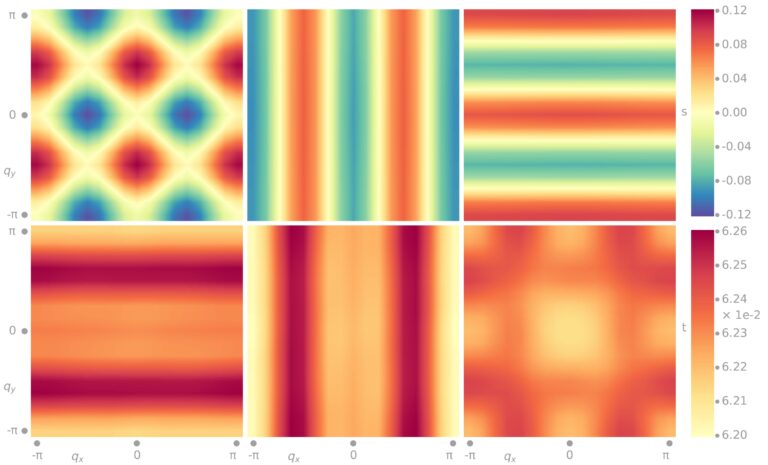
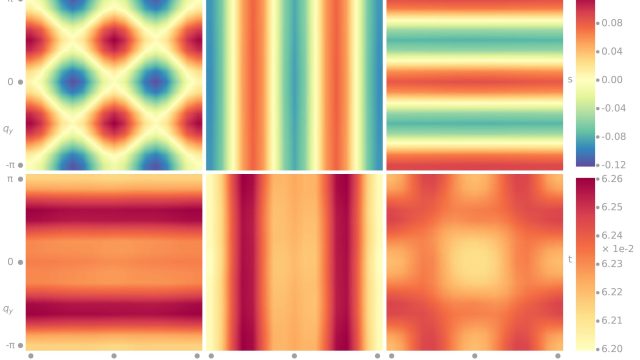
The superconducting pairing gap symmetries for εx=0 are shown in the (100)-(010) plane of the reciprocal lattice; eigenfunctions corresponding to first three eigenvalues in singlet (s) symmetries are in the top panel and triplets (t) are in the lower panel
His method has now been used with great success to study a number of unconventional superconductors, using the power of high-performance computers provided by PRACE to solve the complex DMFT equations. One example involved the investigation of the critical temperature of iron selenide. In bulk, the critical temperature of this material is 8.5K, but recent experiments showed that if a monolayer of it was deposited on top of strontium-titanate, the critical temperature jumped to around 100K. The reason for this jump in critical temperature was originally thought to be due to assistance from electron-phonon interactions, but van Schilfgaarde’s calculations indicate otherwise.
“Our calculations showed that the real reason for this jump in critical temperature is due to a small change in what is known by modellers as the Hubbard Hamiltonian parameter, which causes a massive change in the incoherence of the electrons and thus the critical temperature. We showed in our simulations that if you tweaked this parameter for the material in bulk, the same increase in critical temperature was achieved.”
Strontium ruthenate is another material that has been investigated by van Schilfgaarde. Until a few years ago, it was considered a prime candidate for being a spin triplet superconductor. Discovering such a material is of great interest as it would allow for the creation of Majorana fermions, long-sought exotic particles that are their own antiparticles, and which many think could act as stable qubits that would revolutionise quantum computing.
However, recent experiments have cast doubt on its credentials as a spin triplet superconductor, showing that the temperature of the probe used in the original study may have contaminated the results. “We used our theory to look at strontium ruthenate and showed that three spin triplet states do exists within it, but they are in competition with three spin singlet states,” says van Schilfgaarde. “The spin singlet emerges as being a little stronger, which indicates strontium ruthenate is not the spin triplet superconductor it was widely believed to be.”
The team from King’s College London have now studied enough systems to be fairly confident that their theory is capable of describing many kinds of unconventional superconductors. The method represents a first step towards developing a systematic theory of unconventional superconductivity, which will provide a powerful tool in the search for the holy grail of room-temperature superconductors.
This article was also published in PRACE Digest 2021.
More information:
https://www.kcl.ac.uk/people/mark-van-schilfgaarde
https://www.questaal.org/
https://www.nature.com/articles/s42005-019-0254-1
Resources awarded:
This project was awarded 40 000 000 core hours on Joliot-Curie – Rome, hosted by GENCI at CEA, France
Contact
For all questions about PRACE communications, promotional and press materials, social media, and publications: communication@prace-ri.eu